
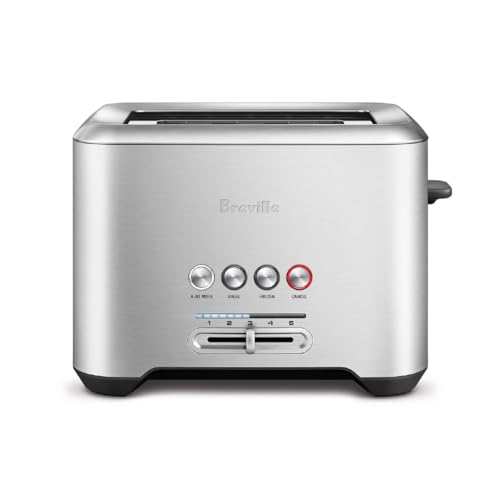
Best overallBreville
Breville BTA720XL Die-Cast 2-Slice Smart Toaster
- Thermostatic (Element IQ) shade control
- 1.5-inch wide slots
Everything you need to know about toaster buying guide: what actually matters, explained plainly.
The single most important specification that determines which toaster is right for your bread: slot width.
Standard slots: 1.0 to 1.25 inches, accommodates standard sandwich bread, English muffins, and standard bagels.
Wide slots: 1.5 inches, accommodates thick-cut artisan bread, thick homemade bread, and large bakery bagels without forcing.
Essential if you regularly buy sourdough boules or 1-inch thick bakery slices.
Long slots: some models offer 12-inch long slots (vs standard 7 inches), accommodates baguette slices and long Italian loaf slices horizontally.
The number of shade positions directly affects how precisely you can set your preferred browning.
Three-position models: light, medium, dark, coarse adjustment, acceptable for one consistent preference.
Six or seven positions: half-step increments, allows dialing in a specific level.
For households with members who prefer different browning levels (one person likes light toast, another likes dark): more positions mean each person can find their setting.
The precision at each position also varies between models.
The crumb tray position determines cleaning ease.
Slide-out bottom tray: accessible from the front or side without moving the toaster.
Built-in tray with latch: requires opening a mechanism.
Budget models sometimes have no tray, crumbs collect inside and require holding the toaster over a bin and shaking.
For a counter against a wall: a tray that slides from the front (rather than the back or sides) is more convenient.
Check price on amazon, Breville BTA840XL Check price on amazon, Cuisinart CPT-435
Higher wattage toasters heat the elements faster and toast more quickly. Budget 2-slice toasters: 700W to 800W. Standard 4-slice: 1,000W to 1,200W. Premium 4-slice (Breville): 1,500W to 1,800W. The practical difference: a 1,500W toaster toasts bread approximately 30 to 60 seconds faster than a 700W toaster at the same shade setting. For a weekday morning where 30 seconds matters: higher wattage is relevant. For casual use: wattage does not meaningfully affect the decision.
The frozen setting extends the heating cycle to compensate for the starting temperature of frozen bread. Standard toaster cycles calibrate to room-temperature bread, a frozen slice contains more energy-absorbing ice that must be melted before the bread surface can brown. Without the frozen setting: frozen bread comes out unevenly toasted (exterior brown, interior still partially frozen/cold). With the frozen setting: the cycle runs 30 to 60 seconds longer, allowing the interior to fully thaw and heat through before the surface begins browning. Most mid-range and premium toasters include this setting; some budget models do not.
Lift-and-look (Breville's term) is a feature that allows the carriage to be manually raised mid-cycle to check the toast's browning progress without canceling the cycle. On a standard toaster: raising the carriage cancels the cycle and ejects the toast, to check browning requires canceling and restarting if underdone. With lift-and-look: press a button or lift the carriage lever gently, the element pauses, the carriage rises, you check browning, and press the lever back down to continue. The cycle resumes from the paused state. Useful for unfamiliar bread types or when using a new shade setting.
A pop-up toaster (this guide's subject) is purpose-built for bread, bagels, and English muffins, fast, efficient, and compact. A toaster oven is a separate appliance that can toast, bake, broil, and reheat, much more versatile, significantly larger, and slower at the specific task of making toast (3 to 5 minutes in a toaster oven vs 1.5 to 2.5 minutes in a toaster). If toast is the only function: a pop-up toaster is faster, more energy-efficient, and takes less counter space. If you also want to reheat pizza, bake cookies, roast vegetables, or broil without your main oven: a toaster oven covers more tasks. Both in the same kitchen is common, toaster for daily toast, toaster oven for reheating and small baking tasks.

