
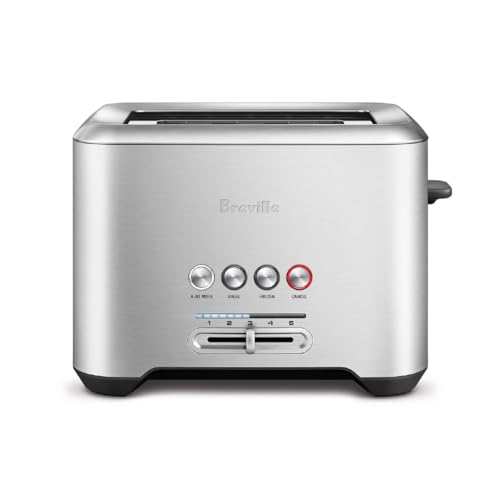
Best overallBreville
Breville BTA720XL Die-Cast 2-Slice Smart Toaster
- Thermostatic (Element IQ) shade control
- 1.5-inch wide slots
Four questions identify the right toaster: your bread type and thickness, household size, budget, and feature priorities. Answer them in order for a direct recommendation without wading through a full
Standing in the toaster aisle staring at a dozen nearly identical boxes is its own kind of decision fatigue. Learning how to choose a toaster gets a lot faster once you narrow it to four questions: bread type, household size, how often you'll use it, and which extras actually matter to you.
What bread do you toast most often?
Toaster Buying Guide, full specification breakdown Best Toasters, full ranked list Best 2-Slice Toasters, compact models only
Best Toasters of 2026: Ranked and ReviewedToasters · List Best 2-Slice Toasters: Compact and Efficient PicksToasters · List
What bread do you toast most often?
Just bagels, regularly: any model with a bagel mode and 1.25-inch minimum slots.
Toaster Buying Guide, full specification breakdown Best Toasters, full ranked list Best 2-Slice Toasters, compact models only
For daily toast eaters over 4 to 6 years: yes, if uneven browning bothers you. At shade setting 3 on a Breville: the top edge matches the center matches the bottom edge. At shade setting 3 on a budget toaster: the top edge and bottom edge are commonly 1.5 shades darker than the center. Whether this matters depends on whether you notice uneven toast as a nuisance or not. For households where someone regularly complains about the edges being too dark: the Breville solves this.
Wide-slot toasters (1.5 inches) are required for thick sourdough. Recommended: Breville BTA840XL (1.5-inch wide slots, even heat distribution), Cuisinart CPT-435 (1.5-inch slots, consistent browning), or KitchenAid KMT4116 long-slot (1.5-inch wide, 12-inch long slots for wider boule slices). Verify the slot width specification before purchasing, some toasters listed as 'wide slot' are 1.25 inches, which fits standard bagels but not thick artisan bread without forcing.
For fire safety: yes, after each use is the safest practice. A plugged-in toaster with accumulated crumbs is a fire risk if a crumb makes contact with the element during a power surge or if a small animal or insect triggers the mechanism. Practically: unplugging after each use and re-plugging the next morning adds approximately 3 to 5 seconds per use. Most households leave the toaster plugged in. The fire risk is real but low, the most effective risk reduction is cleaning the crumb tray every 3 to 5 uses, which removes the fuel source regardless of whether the toaster is plugged in.

