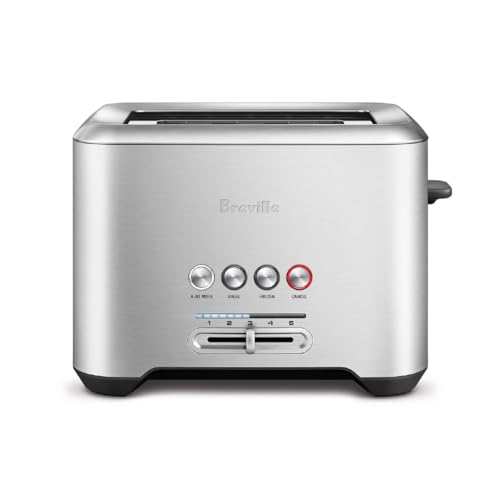
3-star rating across nearly 10,000 buyers and toast boost lever raises short slices for easy removal without touching the hot housing. The tradeoff: browning is noticeably less even at the slot edges than the West Bend or Cuisinart options.
4-slice capacity
1.2-inch slots
Toast boost lever
6-shade settings
Bagel and cancel functions
Pros
One of the least expensive 4-slice toasters that still holds a 4.3-star rating across nearly 10,000 buyers
Toast boost lever raises short slices for easy removal without touching the hot housing
Simple mechanical dial that's easy to use and unlikely to need recalibration
Wide enough slots (1.2 inches) for most sandwich bread and standard bagels
Cons
Browning is noticeably less even at the slot edges than the West Bend or Cuisinart options
1-year warranty, shorter than the Cuisinart CPT-122's 3-year coverage
Housing is stamped metal and plastic, feels less substantial than die-cast competitors
Prices and availability change, so confirm on Amazon.
It stands out for clear windows let you watch browning progress without lifting the lever and compact 7-inch footprint is one of the smallest toasters in this roundup. 1-inch slots are narrow, thick artisan bread and large bagels compress noticeably.
Clear side windows to watch toast browning
1.1-inch slots
6-shade settings
Removable crumb tray
Compact 7-inch-wide housing
Pros
Clear windows let you watch browning progress without lifting the lever
Compact 7-inch footprint is one of the smallest toasters in this roundup
Simple to clean, no crevices around the viewing windows to trap crumbs
Cons
1.1-inch slots are narrow, thick artisan bread and large bagels compress noticeably
Plastic housing feels less substantial than metal-bodied competitors
Viewing windows fog slightly with steam on longer cycles, reducing visibility
Prices and availability change, so confirm on Amazon.
Most toasters look identical on a store shelf. It stands out for cuisinart's shading consistency at a fraction of the price of premium models and compact 8-inch footprint fits tight counters and small apartments. 1 inches wide, squeezes thick artisan bread.
Compact footprint under 8 inches wide
6-setting shade dial
Slide-out crumb tray
Cord storage in the base
Bagel/defrost/toast function switch
Pros
Cuisinart's shading consistency at a fraction of the price of premium models
Compact 8-inch footprint fits tight counters and small apartments
Slide-out crumb tray empties without disassembling the toaster
3-year warranty, standard across the Cuisinart lineup
Cons
Slots are around 1.1 inches wide, squeezes thick artisan bread
No lift-and-look; canceling mid-cycle to check toast resets the cycle
Plastic housing runs warmer to the touch than metal-bodied models
Prices and availability change, so confirm on Amazon.
This shortlist is the product of research, not advertising. We cross-checked manufacturer specs against independent reviews and long-term owner feedback, then ranked by value for real use cases.
Mistakes buyers often make
Choosing the cheapest option without checking warranty and support quality.
Assuming all models work with your existing setup, verify compatibility first.
Skipping the measurements: returns most often come from fit surprises.
Chasing the newest release when last year's model does the same job for less.
How we chose these picks
We started from manufacturer specifications and feature lists, the verifiable foundation.
We weighed reputable independent reviews from established tech and consumer publications.
We read large volumes of verified-owner feedback to find patterns in reliability and satisfaction.
We scored value: what you get for the price, not just absolute performance.
We excluded products with thin, suspicious, or heavily incentivized review profiles.
We don't claim hands-on testing we haven't done. Assessments synthesize manufacturer specifications, reputable independent reviews and documented owner feedback. Read our methodology.
Before you buy
Buying guide
How to choose: the factors that matter
Capacity and sizing, Measure your space and your actual use before falling for bigger-is-better. The right size is the one that fits your routine, not the spec sheet's maximum.
Build quality and materials, Heavier-gauge materials, tight tolerances, and solid joints outlast thin, rattly construction. In reviews, look for longevity comments over first-impression praise.
Ease of use and setup, Clear instructions, intuitive controls, and minimal assembly separate daily drivers from garage ornaments.
Maintenance and cleaning, Whatever you buy will need cleaning. Removable, dishwasher-safe, or wipe-clean parts get maintained; fiddly ones get neglected.
Warranty and support, A multi-year warranty signals the manufacturer expects it to last. Check what's actually covered, motors and frames matter more than accessories.
The bottom line
There's no single 'best' here, only the best match for your situation. Start from your must-have features, then choose the least expensive pick that covers them.
Answers
Frequently asked questions
What are the best toasters right now?
Our top pick is the Breville BTA840XL Die-Cast 4-Slice Smart Toaster (top pick), because thermostatic shade control, same shade setting produces consistent results on a cold and warm toaster. The runner-up is the Cuisinart CPT-435C Countdown 4-Slice Stainless Steel Toaster, followed by the Breville BTA720XL Die-Cast 2-Slice Smart Toaster.
Is the Breville BTA840XL Die-Cast 4-Slice Smart Toaster worth it?
For most buyers, yes. It ranks #1 in our toasters research, though heavier than most toasters (5.5 lb), moving it to clean under is slightly more effort.
What makes an expensive toaster better than a $20 one?
Browning evenness is the primary quality difference. Budget toasters heat from elements that are closer together at the top and bottom than at the center, the top and bottom edges of the toast darken faster than the middle. A Breville or Cuisinart toaster uses more closely spaced elements and higher wattage to distribute heat evenly from the top to the bottom of the slot, producing uniform browning. The second difference is consistency across cycles: a budget toaster at shade 3 produces different results on a cold toast vs a warm toaster, a quality toaster uses a thermostat that compensates for the starting temperature of the element to produce consistent results on every cycle. The third difference: slot width, quality toasters have 1.5-inch slots that accommodate thick bread and bagels; budget toasters often have 1-inch slots that squeeze thick items and produce white streaks where the bread contacted the element housing.
What is bagel mode on a toaster?
Bagel mode toasts only the inner (cut) side of the bagel and warms the outer curved side without toasting it. A bagel placed cut-side-in: standard toasting heats both sides equally, producing a crunchy exterior on a bagel that was meant to stay soft. Bagel mode (on most toasters): the inner element runs at full heat, the outer element runs at reduced heat or only provides gentle warming. The result: a toasted, crispy inner surface with a warm, soft outer crust. Implementation quality varies, some budget bagel modes are only marginally different from standard; Cuisinart and Breville bagel modes produce the correct single-side toast on most bagel thicknesses.
Are wide-slot toasters necessary?
For standard sandwich bread (3/4-inch thick): no, any slot accommodates this. For thick-cut bread (artisan sourdough, bakery slices, 1-inch thick): a 1.5-inch wide slot is required, a narrow slot squeezes the bread against the element housing and toasts unevenly. For bagels: a 1.25-inch minimum slot accommodates a standard bagel thickness. Most quality toasters (Breville, Cuisinart) include 1.5-inch wide slots.
How do I clean a toaster properly?
Remove and empty the crumb tray after every 3 to 5 uses, most quality toasters have a slide-out crumb tray at the bottom. A full crumb tray can cause uneven heating and is a fire risk. Clean the interior: unplug the toaster, hold it over the sink, and shake gently to dislodge crumbs not captured by the tray. Use a soft pastry brush to sweep the interior. Do not use water in the interior, electrical components are in the lower body near the heating element. The exterior: wipe with a slightly damp cloth; for stainless steel exteriors, wipe in the direction of the grain to avoid scratches.
What shade setting should I use for toast?
Most toasters use a 1 to 6 or 1 to 7 shade scale. Setting 2 to 2.5: lightly golden, soft, minimal crust formation, suitable for bread intended for dipping in olive oil or for very thin slices. Setting 3 to 3.5: the standard household preference, golden brown, light crisp exterior, fully heated interior. Setting 4 to 4.5: medium-dark, firm crust, more pronounced toast flavor from caramelization, preferred for toast with butter or jam that benefits from a sturdy surface. Setting 5 to 6: dark, near-burnt in spots, preferred by a minority; useful for bagels where maximum internal crispiness is desired. For first use: start at 3 and adjust by half-step increments on subsequent uses to find your preference.
Is a 4-slice toaster worth it over a 2-slice?
For a household of 3 or more people eating toast at the same meal: yes, a 4-slice toaster reduces batch time from two cycles (2+2) to one cycle, saving 1 to 2 minutes per person at the table. For a household of 1 to 2: the extra counter footprint of a 4-slice toaster is the main cost. A 4-slice toaster is approximately 50% wider than a 2-slice. If you regularly make toast for 4 people simultaneously: the 4-slice is clearly the right choice. If you make 2 slices at a time 95% of the time: the 2-slice saves meaningful counter space.