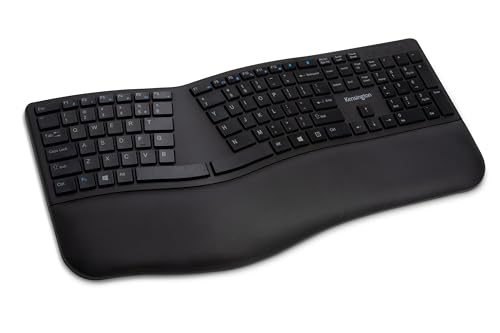
Best Fully SplitKinesis
Kinesis Freestyle2 Blue for PC (9 Inch Separation)
- Fully split halves connected by pivot tether, 0 to 9 inches of separation
- Standard QWERTY stagger, no columnar relearning
Microsoft
Sponsored link · confirm price and availability on Amazon · updated
Yes, for the right buyer. The Microsoft Ergonomic Keyboard (LXM-00004) ranks #4 in our Best Ergonomic Keyboards for Programmers list. Its biggest strength: crisp key feel for a membrane keyboard, better than most budget splits. The main caveat: no tenting or adjustable splay, the angle is fixed at the factory.
It stands out for crisp key feel for a membrane keyboard, better than most budget splits and conventional layout keeps the learning curve short, typically under a week. The tradeoff: no tenting or adjustable splay, the angle is fixed at the factory.
It stands out for more conventional key layout than the Sculpt reduces adjustment time and wired USB eliminates any dongle-loss risk. The tradeoff: no tenting or adjustable splay angle.
Pros
Cons
Buy it if you're…
Think twice if this matters to you
| List | Rank |
|---|---|
| Best Ergonomic Keyboards for Programmers | #4 / 10 |
| Best Ergonomic Keyboards Under $100 | #4 / 10 |
Products ranked near it in our research, each better for a slightly different buyer.
Read the full guides
Yes, for the right buyer. The Microsoft Ergonomic Keyboard (LXM-00004) ranks #4 in our Best Ergonomic Keyboards for Programmers list. Its biggest strength: crisp key feel for a membrane keyboard, better than most budget splits. The main caveat: no tenting or adjustable splay, the angle is fixed at the factory.
Based on our research it suits programmers and budgets under $100. It's ranked #4 of 10 in our Best Ergonomic Keyboards for Programmers list.
The main trade-offs owners and reviewers point to: no tenting or adjustable splay, the angle is fixed at the factory; wired only, no Bluetooth or wireless option; splay is modest, so it does less for shoulder strain than a fully split board.
Wired USB split layout with cushioned palm rest, Conventional key stagger for a shorter adjustment period, Crisp membrane switch feel and No software or drivers required.
Worth comparing: Kinesis Freestyle2 Blue for PC (9 Inch Separation), Logitech Ergo K860 Wireless Ergonomic Split Keyboard and Perixx Periboard-512B Ergonomic Split Keyboard. Each ranks near it in our research for a slightly different buyer.
It's sold on Amazon. Prices and stock change often, so check the current listing before you buy, our link takes you straight to it.
Not necessarily, but programmers benefit more from split layouts than most users because they type more hours per day and reach for symbols and modifier keys more frequently. A fixed-split keyboard like the Logitech K860 reduces ulnar deviation without requiring separate positioning of two halves. A fully split keyboard like the Kinesis Freestyle2 allows shoulder-width positioning that also addresses shoulder strain, which is the next most common complaint after wrist pain in programmers who type 8+ hours daily. Try a fixed split first; if shoulder and upper back strain persists, upgrade to fully split.
Mechanical switches provide tactile feedback and consistent actuation that reduce the force needed per keystroke over a full day. Over 8 hours of coding, the lower force requirement of a light tactile switch reduces hand fatigue measurably. However, most ergonomic keyboards under 150 dollars use membrane switches, and the ergonomic layout benefit outweighs the switch type. If budget allows, a mechanical split like the Kinesis Advantage2 combines both benefits. If budget is tight, prioritize the split layout over the switch type.