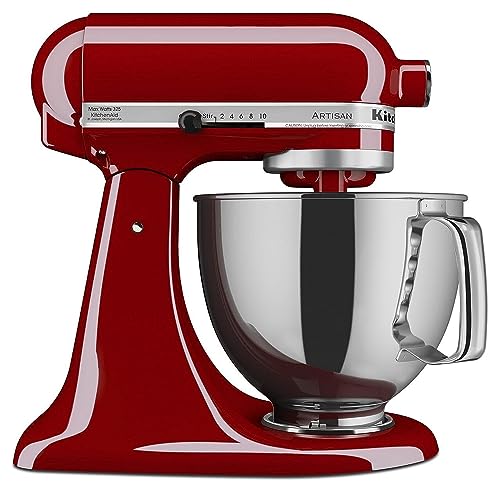
8 stars, the most recipe-referenced and best-documented stand mixer in the category and 15+ official attachments plus 20+ third-party options via the unchanged KitchenAid hub. One caveat, 325W motor strains on stiff bread dough and large batches.
325W continuous-rated motor with 10-speed control
5-quart stainless bowl, tilt-head design
Flat beater, dough hook, and wire whisk included
Compatible with 15+ official KitchenAid hub attachments
35+ color options
Pros
36,000 ratings at 4.8 stars, the most recipe-referenced and best-documented stand mixer in the category
15+ official attachments plus 20+ third-party options via the unchanged KitchenAid hub
Tilt-head design and planetary mixing cover the bowl thoroughly with minimal manual scraping
35+ color options make it the default choice when the mixer stays on the counter permanently
Cons
325W motor strains on stiff bread dough and large batches
5-quart bowl is smaller than most bowl-lift competitors
1-year limited warranty, shorter than Cuisinart's 3-year coverage
Prices and availability change, so confirm on Amazon.
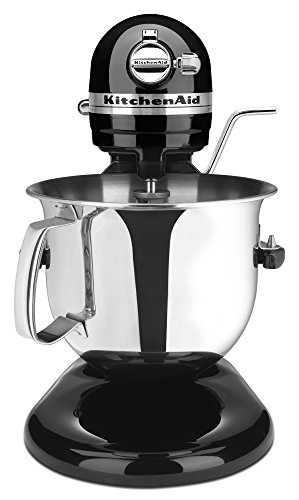
The highlights are bowl-lift design resists the tilt-head flex that develops under sustained heavy bread dough and 575W motor sustains 10-minute kneading cycles without thermal pauses. One caveat, 17+ inch height does not fit under most upper cabinets.
575W motor with bowl-lift design
6-quart stainless bowl
Spiral dough hook, flat beater, and wire whip included
10 speeds
Pros
Bowl-lift design resists the tilt-head flex that develops under sustained heavy bread dough
575W motor sustains 10-minute kneading cycles without thermal pauses
Spiral dough hook centers dough automatically for more even kneading than a C-hook
Cons
17+ inch height does not fit under most upper cabinets
Overkill for households baking cakes and cookies only
Prices and availability change, so confirm on Amazon.
5-quart stainless bowl, tilt-head design. One caveat, attachment ecosystem is a fraction of KitchenAid's, no pasta roller or grinder compatibility with KitchenAid parts.
500W motor with 12-speed control
5.5-quart stainless bowl, tilt-head design
Die-cast zinc body with lever-lock tilt-head
$200 to $280 retail
Pros
500W motor and 5.5-quart bowl outmuscle the KitchenAid Artisan at a lower price
12 speeds provide finer low-end control than the Artisan's 10
The highlights are 7-quart bowl-lift capacity at a price well below KitchenAid's equivalent bowl-lift models and 500W motor handles large batches without strain. One caveat, bowl-lift height requires more overhead counter clearance than a tilt-head.
500W motor with bowl-lift design
7-quart stainless bowl
12 speeds
Dough hook, flat beater, and whisk included
Pros
7-quart bowl-lift capacity at a price well below KitchenAid's equivalent bowl-lift models
500W motor handles large batches without strain
12 speeds give finer control than most bowl-lift competitors at this price
Cons
Bowl-lift height requires more overhead counter clearance than a tilt-head
Smaller attachment ecosystem than KitchenAid
8,400 ratings is a modest sample for a bowl-lift-class purchase
Prices and availability change, so confirm on Amazon.
The highlights are electronic speed sensor holds a set speed under dough resistance rather than bogging down and integrated scale removes a separate measuring step. One caveat, 3,200 ratings is a much smaller review base than KitchenAid's tens of thousands.
550W motor with electronic speed sensor
5-quart stainless bowl with bowl-lift design
Built-in scale for measuring ingredients in the bowl
12 speed settings with timer
Pros
Electronic speed sensor holds a set speed under dough resistance rather than bogging down
Integrated scale removes a separate measuring step
Bowl-lift stability in a lower profile than most bowl-lift competitors
Cons
3,200 ratings is a much smaller review base than KitchenAid's tens of thousands
Limited attachment lineup compared to KitchenAid's hub ecosystem
Priced near KitchenAid's bowl-lift models without the same brand recognition for baking
Prices and availability change, so confirm on Amazon.
3 HP commercial-rated motor with bowl-lift design and 8-quart stainless bowl. One caveat, price and footprint are excessive for anyone baking less than several times per week.
1.3 HP commercial-rated motor with bowl-lift design
8-quart stainless bowl
Spiral dough hook rated for continuous commercial-style use
NSF-certified for commercial kitchen use
Pros
1.3 HP commercial motor rated for continuous use well beyond household duty cycles
8-quart bowl and spiral hook handle the largest home or small-commercial batches without strain
NSF certification signals build quality for near-daily heavy production
Cons
Price and footprint are excessive for anyone baking less than several times per week
4,400 ratings, a small sample given the price tier
No practical benefit over the 6-quart Pro 600 for one to two loaves at a time
Prices and availability change, so confirm on Amazon.
8-star rating across 7,600 reviews matches the standard Artisan's reliability record. One caveat, premium finishes carry a price markup over the standard-color Artisan for identical mechanical performance.
Every pick below earned its place through documented strengths, verified specifications, consistent praise in reputable reviews, and owner-feedback patterns. We don't sell placements, and we don't invent test scores.
Mistakes buyers often make
Choosing the cheapest option without checking warranty and support quality.
Assuming all models work with your existing setup, verify compatibility first.
Skipping the measurements: returns most often come from fit surprises.
Chasing the newest release when last year's model does the same job for less.
How we chose these picks
We started from manufacturer specifications and feature lists, the verifiable foundation.
We weighed reputable independent reviews from established tech and consumer publications.
We read large volumes of verified-owner feedback to find patterns in reliability and satisfaction.
We scored value: what you get for the price, not just absolute performance.
We excluded products with thin, suspicious, or heavily incentivized review profiles.
We don't claim hands-on testing we haven't done. Assessments synthesize manufacturer specifications, reputable independent reviews and documented owner feedback. Read our methodology.
Before you buy
Buying guide
How to choose: the factors that matter
Capacity and sizing, Measure your space and your actual use before falling for bigger-is-better. The right size is the one that fits your routine, not the spec sheet's maximum.
Build quality and materials, Heavier-gauge materials, tight tolerances, and solid joints outlast thin, rattly construction. In reviews, look for longevity comments over first-impression praise.
Ease of use and setup, Clear instructions, intuitive controls, and minimal assembly separate daily drivers from garage ornaments.
Maintenance and cleaning, Whatever you buy will need cleaning. Removable, dishwasher-safe, or wipe-clean parts get maintained; fiddly ones get neglected.
Warranty and support, A multi-year warranty signals the manufacturer expects it to last. Check what's actually covered, motors and frames matter more than accessories.
The bottom line
If you want the short answer: the top pick above suits most buyers, the value pick suits tight budgets, and the specialist picks suit specific needs. Match the pick to your use case, not to the hype.
Answers
Frequently asked questions
What are the best stand mixers right now?
Our top pick is the KitchenAid Artisan 5-Qt. Tilt-Head Stand Mixer (our top pick), because 36,000 ratings at 4.8 stars, the most recipe-referenced and best-documented stand mixer in the category. The runner-up is the KitchenAid KSM6573COB Professional 6000 HD 6-Qt. Bowl-Lift Stand Mixer, followed by the KitchenAid KP26M1XER Professional 600 Series 6-Qt. Bowl-Lift.
Is the KitchenAid Artisan 5-Qt. Tilt-Head Stand Mixer worth it?
For most buyers, yes. It ranks #1 in our stand mixers research, though 325W motor strains on stiff bread dough and large batches.
What size stand mixer do I need?
Bowl capacity determines how much you can mix in one batch. 4.5-quart: standard home baker size, fits one to two dozen cookies, a 3-layer cake, or a standard loaf of bread. Appropriate for 1 to 4-person households baking 1 to 2 times per month. 5 to 5.5-quart: the most versatile home size, fits double batches of cookies, two loaves of bread, or large holiday batches. The KitchenAid Artisan 5-quart is the benchmark for this size. 6 to 7-quart: appropriate for serious home bakers, small-batch commercial use, or large families, fits triple batches, 5-pound flour recipes, or bread for a full week. If you bake regularly or in large quantities: the 5.5-quart is the minimum practical size. If you bake occasionally or in small quantities: the 4.5-quart is adequate.
What is the difference between a tilt-head and bowl-lift stand mixer?
Tilt-head stand mixers: the motor head tilts back on a hinge to allow access to the bowl from above, the bowl is stationary. Examples: KitchenAid Artisan, most 4.5 to 5-quart models. Advantages: easier bowl access, simpler attachment changes, lower height profile for under-cabinet storage. Disadvantages: the tilt-head mechanism can develop play over years of heavy use, reducing the precision of the attachment-to-bowl contact. Bowl-lift stand mixers: the motor head is fixed and the bowl lifts up to engage the attachment on a yoke mechanism. Examples: KitchenAid Professional 600, KitchenAid Pro 5 Plus, Cuisinart SM-70. Advantages: more stable during heavy dough mixing (the bowl clamps on the yoke rather than depending on the tilt-head's contact precision), handles heavier loads with less motor strain. Disadvantages: taller profile (often 17+ inches, does not fit under upper cabinets), more complex attachment access. For bread bakers: bowl-lift is preferred. For cake and cookie bakers: tilt-head is fine.
What attachments does a stand mixer come with and what else can I add?
Standard attachments included with most stand mixers: flat beater (for cake batter, cookie dough, and most mixing tasks), dough hook (for bread and pasta dough), and wire whip (for whipping cream, meringue, and egg whites). These three attachments cover 95% of stand mixer tasks. Common add-on accessories (sold separately): pasta roller and cutter set, food grinder/meat grinder, vegetable sheet cutter, ice cream maker bowl, spiralizer, grain mill, and citrus juicer. KitchenAid's attachment hub compatibility is the standard in the industry, over 15 official KitchenAid attachments plus third-party alternatives share the same hub. When purchasing a stand mixer: KitchenAid's attachment ecosystem is the primary reason most home bakers choose it over equivalent competitors. A KitchenAid Artisan purchased today uses the same attachments as a KitchenAid from 1993.
What is the best stand mixer for bread baking?
Both use bowl-lift designs that handle dense bread dough (80%+ hydration, 5-pound flour batches) without the tilt-head instability that develops on smaller tilt-head models over repeated bread batches. For occasional bread baking (once per week): the KitchenAid Artisan 5-quart tilt-head handles standard bread recipes without difficulty. For frequent bread baking (3+ times per week) or large loaves: the bowl-lift models are the correct tool.