
Skip to content
BuyOnceRight: buy once, buy right
Stand Mixers · Best picks

Best Stand Mixers for Bread: Top Picks for Kneading Dough

Our research-backed shortlist of the 10 best Stand mixers for 2026, what each pick does well, where it falls short, and who should buy it.

On this page

Our top picks

Short on time? Our top recommendation is the KitchenAid KP26M1XER Professional 600 Series 6-Qt. Bowl-Lift (best overall). Here's how the shortlist breaks down.

  1. KitchenAid KP26M1XER Professional 600 Series 6-Qt. Bowl-Lift

    #1 · Best overall

    KitchenAid KP26M1XER Professional 600 Series 6-Qt. Bowl-Lift

    Bowl-lift design holds the bowl rigid against a yoke, eliminating the tilt-head flex that develops under repeated heavy dough

  2. Bosch Universal Plus Stand Mixer MUM6N10UC

    #2

    Bosch Universal Plus Stand Mixer MUM6N10UC

    Motor-in-base layout delivers the highest usable kneading torque of any consumer stand mixer

  3. Breville BEM825BAL the Bakery Chef Stand Mixer

    #3

    Breville BEM825BAL the Bakery Chef Stand Mixer

    Electronic speed sensor actively compensates for dough resistance, holding a set speed rather than bogging down like standard AC motors

  4. KitchenAid KSM70SKXX 7-Qt. Bowl-Lift Stand Mixer

    #4

    KitchenAid KSM70SKXX 7-Qt. Bowl-Lift Stand Mixer

    7-quart bowl handles triple batches or three standard loaves in one cycle, the largest practical capacity in the KitchenAid consumer lineup

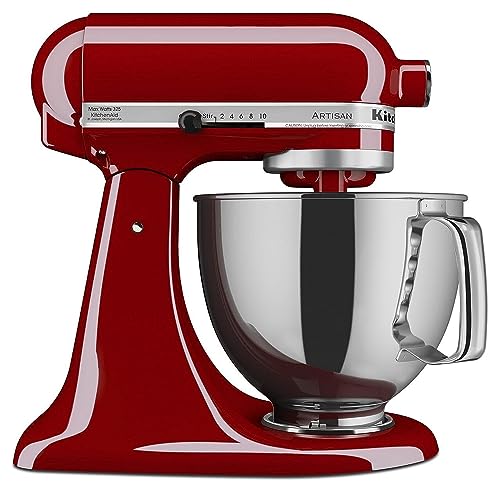
  5. KitchenAid KSM150PSER Artisan 5-Qt. Tilt-Head Stand Mixer

    #5

    KitchenAid KSM150PSER Artisan 5-Qt. Tilt-Head Stand Mixer

    Handles standard single-loaf bread recipes without difficulty at speed 2

  6. Cuisinart SM-70 7-Qt. 12-Speed Stand Mixer

    #6

    Cuisinart SM-70 7-Qt. 12-Speed Stand Mixer

    7-quart bowl-lift stability at a lower price than KitchenAid's equivalent bowl-lift models

  7. KitchenAid KSMC895 Commercial Series 8-Qt. Bowl-Lift

    #7

    KitchenAid KSMC895 Commercial Series 8-Qt. Bowl-Lift

    1.3 HP commercial motor is rated for continuous use well beyond household duty cycles

  8. Cuisinart SM-50BCC 5.5-Qt. 12-Speed Stand Mixer

    #8

    Cuisinart SM-50BCC 5.5-Qt. 12-Speed Stand Mixer

    500W motor outperforms the KitchenAid Artisan on stiff dough and bagel batches at a lower price

  9. KitchenAid KSM8990OB Commercial 8-Qt. Stand Mixer (Onyx Black)

    #9

    KitchenAid KSM8990OB Commercial 8-Qt. Stand Mixer (Onyx Black)

    Commercial-rated motor and NSF certification suit dedicated home bakers producing bread multiple times weekly

  10. KitchenAid KSM3311XBM Artisan Mini 3.5-Qt.

    #10

    KitchenAid KSM3311XBM Artisan Mini 3.5-Qt.

    Full KitchenAid attachment compatibility in a compact 3.5-quart body, no functional attachment downgrade versus the 5-quart Artisan

Jump to the full breakdowns
Compare

At a glance

The specs and traits that separate these picks, side by side.

How to read this table
Why it stands out: its biggest strength
Keep in mind: the main trade-off
Best for: the buyer it suits
Comparison: Best Stand Mixers for Bread: Top Picks for Kneading Dough
PickWhy it stands outKeep in mindBest forPrice
KitchenAid KP26M1XER Professional 600 Series 6-Qt. Bowl-Lift product photo
KitchenAid KP26M1XER Professional 600 Series 6-Qt. Bowl-Lift
Bowl-lift design holds the bowl rigid against a yoke, eliminating the tilt-head flex that develops under repeated heavy dough17+ inch height does not fit under most upper cabinetsbreadCheck price
Bosch Universal Plus Stand Mixer MUM6N10UC product photo
Bosch Universal Plus Stand Mixer MUM6N10UC
Motor-in-base layout delivers the highest usable kneading torque of any consumer stand mixerAttachment ecosystem is much smaller than KitchenAid'sbreadCheck price
Breville BEM825BAL the Bakery Chef Stand Mixer product photo
Breville BEM825BAL the Bakery Chef Stand Mixer
Electronic speed sensor actively compensates for dough resistance, holding a set speed rather than bogging down like standard AC motors3,200 ratings is a much smaller review base than KitchenAid's tens of thousandsbreadCheck price
KitchenAid KSM70SKXX 7-Qt. Bowl-Lift Stand Mixer product photo
KitchenAid KSM70SKXX 7-Qt. Bowl-Lift Stand Mixer
7-quart bowl handles triple batches or three standard loaves in one cycle, the largest practical capacity in the KitchenAid consumer lineupLarge footprint and height make storage and under-cabinet placement difficultbreadCheck price
KitchenAid KSM150PSER Artisan 5-Qt. Tilt-Head Stand Mixer product photo
KitchenAid KSM150PSER Artisan 5-Qt. Tilt-Head Stand Mixer
Handles standard single-loaf bread recipes without difficulty at speed 2325W motor and C-hook are not built for double-loaf batches or frequent heavy dough usebreadCheck price
Cuisinart SM-70 7-Qt. 12-Speed Stand Mixer product photo
Cuisinart SM-70 7-Qt. 12-Speed Stand Mixer
7-quart bowl-lift stability at a lower price than KitchenAid's equivalent bowl-lift modelsCuisinart's attachment ecosystem for the SM-70 hub is far smaller than KitchenAid'sbreadCheck price
KitchenAid KSMC895 Commercial Series 8-Qt. Bowl-Lift product photo
KitchenAid KSMC895 Commercial Series 8-Qt. Bowl-Lift
1.3 HP commercial motor is rated for continuous use well beyond household duty cyclesPrice and footprint are excessive for anyone baking less than several times per weekbreadCheck price
Cuisinart SM-50BCC 5.5-Qt. 12-Speed Stand Mixer product photo
Cuisinart SM-50BCC 5.5-Qt. 12-Speed Stand Mixer
500W motor outperforms the KitchenAid Artisan on stiff dough and bagel batches at a lower priceTilt-head design still develops flex over years of heavy repeated bread use, same as any tilt-headbreadCheck price
KitchenAid KSM8990OB Commercial 8-Qt. Stand Mixer (Onyx Black) product photo
KitchenAid KSM8990OB Commercial 8-Qt. Stand Mixer (Onyx Black)
Commercial-rated motor and NSF certification suit dedicated home bakers producing bread multiple times weeklyLarge size and weight make it a permanent counter fixture, not a stored appliancebreadCheck price
KitchenAid KSM3311XBM Artisan Mini 3.5-Qt. product photo
KitchenAid KSM3311XBM Artisan Mini 3.5-Qt.
Full KitchenAid attachment compatibility in a compact 3.5-quart body, no functional attachment downgrade versus the 5-quart Artisan3.5-quart bowl caps out well below a full loaf-and-a-half batchbreadCheck price
In depth

The 10 best stand mixers, explained

Why each made the cut, where it falls short, and who it suits best.

KitchenAid KP26M1XER Professional 600 Series 6-Qt. Bowl-Lift
Best overall

1. KitchenAid KP26M1XER Professional 600 Series 6-Qt. Bowl-Lift

KitchenAid

The highlights are bowl-lift design holds the bowl rigid against a yoke, eliminating the tilt-head flex that develops under repeated heavy dough and 575W motor sustains 10-minute kneading cycles without the warm-up pauses smaller tilt-head motors need. Keep in mind that 17+ inch height does not fit under most upper cabinets.

  • 575W motor with bowl-lift design
  • 6-quart stainless bowl
  • Spiral dough hook, flat beater, and wire whip included
  • 10 speeds
  • Handles 8-pound flour batches

Pros

  • Bowl-lift design holds the bowl rigid against a yoke, eliminating the tilt-head flex that develops under repeated heavy dough
  • 575W motor sustains 10-minute kneading cycles without the warm-up pauses smaller tilt-head motors need
  • Spiral dough hook centers dough automatically instead of pushing it to one side of the bowl
  • 6-quart bowl handles two standard loaves or one large artisan batch per cycle

Cons

  • 17+ inch height does not fit under most upper cabinets
  • Bowl-lift mechanism is slower to load and unload than a tilt-head for quick single-item tasks
Bosch Universal Plus Stand Mixer MUM6N10UC

2. Bosch Universal Plus Stand Mixer MUM6N10UC

Bosch

5-quart stainless bowl, holds 8 cups of flour. Keep in mind that attachment ecosystem is much smaller than KitchenAid's.

  • 500W motor with bowl-drive (motor-in-base) mechanism
  • 6.5-quart stainless bowl, holds 8 cups of flour
  • Spiral dough hook, balloon whisk, and cookie paddles included
  • Motor-in-base design maximizes torque without head leverage limits

Pros

  • Motor-in-base layout delivers the highest usable kneading torque of any consumer stand mixer
  • Handles 8-pound flour batches, four standard loaves, in a single continuous cycle
  • Bowl-drive geometry eliminates dough-climbing up the hook shaft, a common head-drive problem
  • Costs less than a comparable KitchenAid bowl-lift despite more raw power

Cons

  • Attachment ecosystem is much smaller than KitchenAid's
  • Covered bowl makes adding ingredients mid-mix less intuitive than a tilt-head
  • 1-year limited warranty versus KitchenAid's longer coverage
Breville BEM825BAL the Bakery Chef Stand Mixer

3. Breville BEM825BAL the Bakery Chef Stand Mixer

Breville

The highlights are electronic speed sensor actively compensates for dough resistance, holding a set speed rather than bogging down like standard AC motors and integrated scale removes a separate measuring step for flour and liquids. Keep in mind that 3,200 ratings is a much smaller review base than KitchenAid's tens of thousands.

  • 550W motor with electronic speed sensor that maintains speed under load
  • 5-quart stainless bowl with bowl-lift design
  • Built-in scale for measuring ingredients directly in the bowl
  • Timer function and 12 speed settings

Pros

  • Electronic speed sensor actively compensates for dough resistance, holding a set speed rather than bogging down like standard AC motors
  • Integrated scale removes a separate measuring step for flour and liquids
  • Bowl-lift stability with a lower profile than most bowl-lift competitors

Cons

  • 3,200 ratings is a much smaller review base than KitchenAid's tens of thousands
  • Breville's attachment lineup for this model is limited compared to KitchenAid's hub ecosystem
  • Price sits at a premium similar to KitchenAid's bowl-lift models without the same brand recognition for baking
KitchenAid KSM70SKXX 7-Qt. Bowl-Lift Stand Mixer

4. KitchenAid KSM70SKXX 7-Qt. Bowl-Lift Stand Mixer

KitchenAid

The highlights are 7-quart bowl handles triple batches or three standard loaves in one cycle, the largest practical capacity in the KitchenAid consumer lineup and 800W motor keeps pace with large dense-dough batches that would tax a 6-quart bowl-lift. Keep in mind that large footprint and height make storage and under-cabinet placement difficult.

  • 800W motor with bowl-lift design
  • 7-quart stainless bowl
  • Spiral dough hook, flat beater, and wire whip included
  • 10 speeds

Pros

  • 7-quart bowl handles triple batches or three standard loaves in one cycle, the largest practical capacity in the KitchenAid consumer lineup
  • 800W motor keeps pace with large dense-dough batches that would tax a 6-quart bowl-lift
  • Spiral dough hook centers large dough masses consistently across the bigger bowl diameter

Cons

  • Large footprint and height make storage and under-cabinet placement difficult
  • Overkill capacity for single-loaf or small-batch bakers
  • Price sits near the top of the consumer stand mixer range
KitchenAid KSM150PSER Artisan 5-Qt. Tilt-Head Stand Mixer

5. KitchenAid KSM150PSER Artisan 5-Qt. Tilt-Head Stand Mixer

KitchenAid

8 stars, the deepest bread-recipe and troubleshooting documentation of any stand mixer. Keep in mind that 325W motor and C-hook are not built for double-loaf batches or frequent heavy dough use.

  • 325W continuous-rated motor with 10-speed control
  • 5-quart stainless bowl, tilt-head design
  • C-hook dough hook, flat beater, and wire whisk included
  • Compatible with 12+ official KitchenAid hub attachments

Pros

  • Handles standard single-loaf bread recipes without difficulty at speed 2
  • 36,000 ratings at 4.8 stars, the deepest bread-recipe and troubleshooting documentation of any stand mixer
  • Tilt-head design is faster to load for a single weekly loaf than a bowl-lift
  • Attachment hub opens the door to a pasta roller or grinder without buying a second machine

Cons

  • 325W motor and C-hook are not built for double-loaf batches or frequent heavy dough use
  • Motor runs warm after 4 to 5 minutes of continuous stiff-dough kneading
  • Tilt-head latch can develop slight play under years of repeated bread stress
Cuisinart SM-70 7-Qt. 12-Speed Stand Mixer

6. Cuisinart SM-70 7-Qt. 12-Speed Stand Mixer

Cuisinart

The highlights are 7-quart bowl-lift stability at a lower price than KitchenAid's equivalent bowl-lift models and 500W motor handles large dough batches without the strain a tilt-head at this wattage would show. Keep in mind that cuisinart's attachment ecosystem for the SM-70 hub is far smaller than KitchenAid's.

  • 500W motor with bowl-lift design
  • 7-quart stainless bowl
  • 12 speeds
  • Dough hook, flat beater, and whisk included

Pros

  • 7-quart bowl-lift stability at a lower price than KitchenAid's equivalent bowl-lift models
  • 500W motor handles large dough batches without the strain a tilt-head at this wattage would show
  • 12 speeds give finer low-end control for gentle bread-starter mixing than most bowl-lift competitors

Cons

  • Cuisinart's attachment ecosystem for the SM-70 hub is far smaller than KitchenAid's
  • 8,400 ratings is a modest review base for a bowl-lift-class purchase
  • Bowl-lift height still requires open counter clearance above the machine
KitchenAid KSMC895 Commercial Series 8-Qt. Bowl-Lift

7. KitchenAid KSMC895 Commercial Series 8-Qt. Bowl-Lift

KitchenAid

3 HP commercial-rated motor with bowl-lift design and 8-quart stainless bowl. Keep in mind that price and footprint are excessive for anyone baking less than several times per week.

  • 1.3 HP commercial-rated motor with bowl-lift design
  • 8-quart stainless bowl
  • Spiral dough hook rated for continuous commercial-style use
  • NSF-certified for commercial kitchen use

Pros

  • 1.3 HP commercial motor is rated for continuous use well beyond household duty cycles
  • 8-quart bowl and spiral hook handle the largest home or small-commercial dough batches without motor strain
  • NSF certification signals build quality appropriate for near-daily heavy bread production

Cons

  • Price and footprint are excessive for anyone baking less than several times per week
  • 4,400 ratings, a small sample given the price tier
  • No practical benefit over the 6-quart Pro 600 for households making one to two loaves at a time
Cuisinart SM-50BCC 5.5-Qt. 12-Speed Stand Mixer

8. Cuisinart SM-50BCC 5.5-Qt. 12-Speed Stand Mixer

Cuisinart

5-quart stainless bowl, tilt-head design. Keep in mind that tilt-head design still develops flex over years of heavy repeated bread use, same as any tilt-head.

  • 500W motor with 12-speed control
  • 5.5-quart stainless bowl, tilt-head design
  • Die-cast zinc body with lever-lock tilt-head
  • $200 to $280 retail

Pros

  • 500W motor outperforms the KitchenAid Artisan on stiff dough and bagel batches at a lower price
  • 5.5-quart bowl handles a double-loaf batch that a 5-quart tilt-head cannot
  • Lever-lock tilt-head holds position more firmly under dough stress than a spring latch

Cons

  • Tilt-head design still develops flex over years of heavy repeated bread use, same as any tilt-head
  • Smaller attachment ecosystem than KitchenAid limits future expansion
  • 12,800 ratings is solid but well below KitchenAid's community size
KitchenAid KSM8990OB Commercial 8-Qt. Stand Mixer (Onyx Black)

9. KitchenAid KSM8990OB Commercial 8-Qt. Stand Mixer (Onyx Black)

KitchenAid

3 HP commercial motor with bowl-lift design and 8-quart stainless bowl in onyx black finish. Keep in mind that large size and weight make it a permanent counter fixture, not a stored appliance.

  • 1.3 HP commercial motor with bowl-lift design
  • 8-quart stainless bowl in onyx black finish
  • Spiral dough hook rated for continuous use
  • NSF-certified commercial build

Pros

  • Commercial-rated motor and NSF certification suit dedicated home bakers producing bread multiple times weekly
  • 8-quart capacity matches the largest batches most home ovens can bake in one session
  • Onyx black finish distinguishes it visually from the standard commercial silver models

Cons

  • Large size and weight make it a permanent counter fixture, not a stored appliance
  • 3,200 ratings, a limited review base to judge long-term reliability at scale
  • Price is not justified for anyone baking fewer than several loaves per week
  • 250W motor with 10-speed control
  • 3.5-quart stainless bowl, tilt-head design
  • C-hook dough hook, flat beater, and wire whisk included
  • Compatible with the full KitchenAid attachment hub
  • 20% smaller footprint than the full-size Artisan

Pros

  • Full KitchenAid attachment compatibility in a compact 3.5-quart body, no functional attachment downgrade versus the 5-quart Artisan
  • 250W motor handles a single standard loaf (3 cups flour) without strain
  • Smaller footprint suits kitchens without room for a full-size stand mixer

Cons

  • 3.5-quart bowl caps out well below a full loaf-and-a-half batch
  • 250W motor is the least powerful in the KitchenAid consumer lineup, not for double batches or stiff dough
  • Not the right choice for households baking more than one loaf at a time
Head-to-head

Compare the top picks

Torn between our leading picks? These side-by-side comparisons settle it.

How we chose these picks

Every pick below earned its place through documented strengths, verified specifications, consistent praise in reputable reviews, and owner-feedback patterns. We don't sell placements, and we don't invent test scores.

Mistakes buyers often make

  • Buying on brand name alone instead of matching features to your actual use case.
  • Overpaying for headline specs you'll never use, define must-haves first.
  • Ignoring size, compatibility, and ongoing costs (filters, accessories, refills).
  • Trusting star ratings without reading what owners complain about after 6 months.

How we chose these picks

  • We started from manufacturer specifications and feature lists, the verifiable foundation.
  • We weighed reputable independent reviews from established tech and consumer publications.
  • We read large volumes of verified-owner feedback to find patterns in reliability and satisfaction.
  • We scored value: what you get for the price, not just absolute performance.
  • We excluded products with thin, suspicious, or heavily incentivized review profiles.

We don't claim hands-on testing we haven't done. Assessments synthesize manufacturer specifications, reputable independent reviews and documented owner feedback. Read our methodology.

Before you buy

Buying guide

How to choose: the factors that matter

  • Capacity and sizing, Measure your space and your actual use before falling for bigger-is-better. The right size is the one that fits your routine, not the spec sheet's maximum.
  • Build quality and materials, Heavier-gauge materials, tight tolerances, and solid joints outlast thin, rattly construction. In reviews, look for longevity comments over first-impression praise.
  • Ease of use and setup, Clear instructions, intuitive controls, and minimal assembly separate daily drivers from garage ornaments.
  • Maintenance and cleaning, Whatever you buy will need cleaning. Removable, dishwasher-safe, or wipe-clean parts get maintained; fiddly ones get neglected.
  • Warranty and support, A multi-year warranty signals the manufacturer expects it to last. Check what's actually covered, motors and frames matter more than accessories.

The bottom line

There's no single 'best' here, only the best match for your situation. Start from your must-have features, then choose the least expensive pick that covers them.

Answers

Frequently asked questions

What are the best stand mixers for bread right now?

Our top pick is the KitchenAid KP26M1XER Professional 600 Series 6-Qt. Bowl-Lift (best overall), because bowl-lift design holds the bowl rigid against a yoke, eliminating the tilt-head flex that develops under repeated heavy dough. The runner-up is the Bosch Universal Plus Stand Mixer MUM6N10UC, followed by the Breville BEM825BAL the Bakery Chef Stand Mixer.

Is the KitchenAid KP26M1XER Professional 600 Series 6-Qt. Bowl-Lift worth it?

For most buyers, yes. It ranks #1 in our stand mixers for bread research, though 17+ inch height does not fit under most upper cabinets.

Why is a bowl-lift stand mixer better for bread than a tilt-head?

The bowl-lift design clamps the bowl onto a yoke from below, holding it against the dough hook with mechanical force. The tilt-head design holds the head in position with a spring-loaded latch. Under stiff bread dough resistance (especially at 50%+ hydration or with large batch sizes), the tilt-head's spring latch can flex slightly, reducing the precision of the dough hook's path through the dough. Over years of heavy bread baking, this flex can worsen. Bowl-lift models (KitchenAid Pro 600, KitchenAid Pro 5 Plus, Cuisinart SM-70) hold the bowl rigid regardless of dough resistance, producing more consistent kneading on dense or very wet doughs. For bakers making bread once per week or less in standard quantities (one loaf at a time): the flex difference is rarely noticeable. For bakers making 2+ loaves several times per week in heavy dough: bowl-lift is the correct design.

How long does a stand mixer need to knead bread dough?

For a standard stand mixer at speed 2 (the correct bread-kneading speed on all KitchenAid models): 7 to 10 minutes for a standard sandwich loaf at 65% hydration. Signs of proper kneading: the dough pulls completely away from the bowl sides and wraps around the hook in one cohesive mass, the surface is smooth (no surface tears when pulled), and the windowpane test (stretching a small piece thin until translucent) holds without tearing. For high-hydration artisan dough (75%+ hydration): the dough will not fully clear the bowl sides and the hook will appear to just fold the dough rather than kneading it, this is normal for wet dough and 10 to 12 minutes at speed 2 is appropriate. Speed 2 is always the correct speed for bread in any KitchenAid, higher speeds add heat and develop gluten too fast.

Can a standard KitchenAid Artisan handle stiff bagel dough?

With difficulty, and with batch size limitations. Standard bagel dough is 56 to 60% hydration, stiffer than most bread doughs. The KitchenAid Artisan's 325W motor handles one standard batch (6 to 8 bagels from 3 cups flour) without significant strain at speed 2 for 8 to 10 minutes. For a double batch (12 to 16 bagels from 6 cups flour): the tilt-head may flex and the motor may slow noticeably in the final 2 to 3 minutes. The KitchenAid Professional 600 6-quart bowl-lift (575W) handles double batches of bagel dough without the flex or motor slowing. The Bosch Universal Plus handles bagel dough most effectively of all consumer stand mixers, as its motor placement allows maximum torque without leverage limitations. For occasional bagel making in standard batches: the Artisan is fine. For regular large-batch bagel production: Professional 600 or Bosch is the correct investment.

What is the spiral dough hook and is it better than the standard C-hook?

The spiral dough hook (also called a spiral hook or S-hook) spirals around a central post in a corkscrew shape. The standard C-hook (or J-hook) curves in a single arc. The spiral hook: makes consistent full contact with dough at all sizes from small to large batches, self-centers the dough ball on the hook rather than pushing it to one side, and folds the dough more thoroughly in fewer revolutions. The C-hook: less expensive to manufacture, adequate for standard dough sizes, but can push dough to one side of the bowl rather than centering it, resulting in some dough being worked more than other sections. The spiral hook is standard on the KitchenAid Professional 600 and Pro 5 Plus, and is also the hook design used by the Bosch Universal Plus. The tilt-head Artisan uses a C-hook in its standard configuration. If bread baking is a primary use: the Professional 600's spiral hook is a meaningful performance upgrade over the Artisan's C-hook.

Keep researching