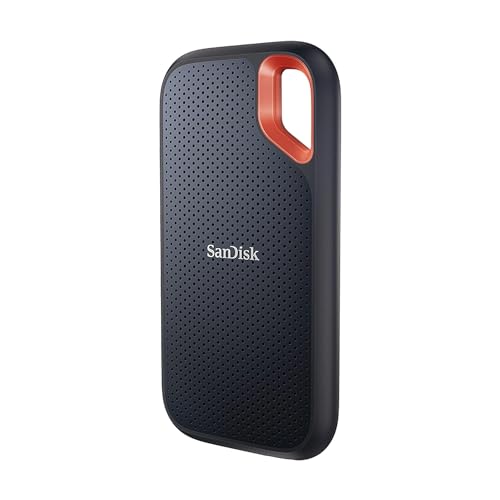
Best RuggedSanDisk
SanDisk Extreme Portable SSD V2
- IP55 water and dust resistance
- USB 3.2 Gen 2, up to 1,050 MB/s read
Samsung
Sponsored link · confirm price and availability on Amazon · updated
Yes, for the right buyer. The Samsung T7 Portable SSD ranks #1 in our Best Portable SSDs 2026 list (best overall). Its biggest strength: best sustained write performance among non-rugged drives. The main caveat: no IP rating, not suitable for field use in wet or dusty environments.
Not the most rugged option, choose the SanDisk Extreme if you need IP protection. 2 Gen 2, up to 1,050 MB/s read and Aluminum body with Dynamic Thermal Guard. Keep in mind that no IP rating, water resistance is notor certified.
Best portable SSD for studio-based video editing. 2 Gen 2, up to 1,050 MB/s read and Aluminum body with Dynamic Thermal Guard. The tradeoff: no IP rating, not suitable for field use in wet or dusty environments.
It is fast, compact, cool-running, and reliable. The only cases where alternatives beat it are rugged field use (SanDisk Extreme, T7 Shield) and price-only purchases where average sustained write performance is acceptable. Best Portable SSDs 2026: Samsung T7, WD My Passport, and SanDisk ExtremePortable SSDs · List Samsung T7 vs SanDisk Extreme: Which Portable SSD Should You Buy?Portable SSDs · ComparisonFrom our full Samsung T7 Portable SSD review
Pros
Cons
Buy it if you're…
Think twice if this matters to you
| List | Rank |
|---|---|
| Best Portable SSDs 2026· Best Overall | #1 / 6 |
| Best Portable SSDs for Video Editing 2026· Best Desktop Use | #3 / 6 |
Products ranked near it in our research, each better for a slightly different buyer.
Yes, for the right buyer. The Samsung T7 Portable SSD ranks #1 in our Best Portable SSDs 2026 list (best overall). Its biggest strength: best sustained write performance among non-rugged drives. The main caveat: no IP rating, not suitable for field use in wet or dusty environments.
Based on our research it suits video editing 2026. It's ranked #1 of 6 in our Best Portable SSDs 2026 list.
The main trade-offs owners and reviewers point to: no IP rating, not suitable for field use in wet or dusty environments; 2-meter drop resistance vs 3 meters on T7 Shield.
USB 3.2 Gen 2, up to 1,050 MB/s read, Aluminum body with Dynamic Thermal Guard, AES 256-bit encryption and Drop resistant to 2 meters.
Worth comparing: SanDisk Extreme Portable SSD V2, WD My Passport SSD and Crucial X10 Pro 2TB Portable SSD. Each ranks near it in our research for a slightly different buyer.
It's sold on Amazon. Prices and stock change often, so check the current listing before you buy, our link takes you straight to it.
USB 3.2 Gen 2 provides 10 Gbps theoretical bandwidth, sufficient for portable SSD speeds up to approximately 1000 MB/s. Thunderbolt 3 and 4 provide 40 Gbps, sufficient for 3000+ MB/s NVMe SSDs. Most portable SSDs use USB 3.2 Gen 2 (1000 MB/s class). Thunderbolt-only portable SSDs (Samsung X5, LaCie Rugged Thunderbolt) are faster but require a Thunderbolt port, not available on most Windows laptops. For a MacBook Pro or a Windows laptop with Thunderbolt: a Thunderbolt SSD achieves 2000-3000 MB/s. For USB-C without Thunderbolt: USB 3.2 Gen 2 SSDs max at 1000 MB/s regardless of the drive's rated speed.
A USB-C to USB-A adapter allows a USB-C portable SSD to connect to a USB-A port. Transfer speeds will be limited by the USB-A port's generation: USB 3.0 (5 Gbps) limits speeds to approximately 400 MB/s read. USB 3.1 Gen 2 (10 Gbps) allows full USB 3.2 Gen 2 SSD speeds. Check the laptop's USB-A port generation before relying on an adapter for full-speed transfers.