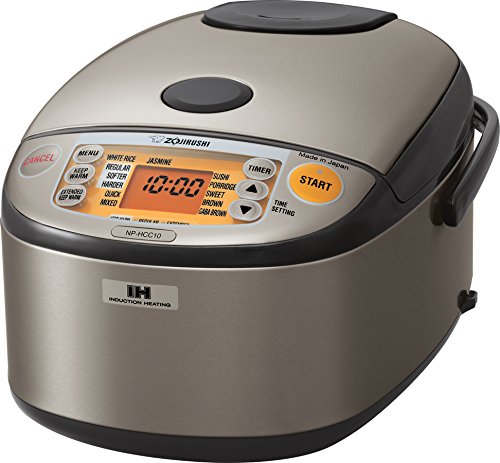
Best OverallZojirushi
Zojirushi NS-TSC10 Micom Rice Cooker
In: Best Rice Cookers for Brown Rice
- Fuzzy logic
- Brown rice setting
Rice cookers make consistent rice with minimal effort.
Standout picks from our best-of lists. Tap any product for features, pros and cons.
In: Best Rice Cookers for Brown Rice
In: Best Rice Cookers Under $50
In: Best Small Rice Cookers for One or Two People
In: Best Rice Cookers for Brown Rice
In: Best Rice Cookers Under $100
In: Best Rice Cookers Under $50
In: Best Rice Cookers
In: Best Small Rice Cookers for One or Two People
Ranked shortlists for specific budgets and use cases. Start with the one that matches yours.
Basic cookers handle white rice well. Fuzzy logic and induction cookers adjust cooking for better texture across rice types.
Capacity depends on household size.
3 cups for small households, 5-10 cups for families.
Fuzzy logic improves results.
Brown rice and porridge modes.
Thick pots heat evenly.
Useful but avoid long holds.
Research-based picks from specs, independent reviews and owner feedback.
No paid placements, ever.
Our methodologyOne of our strongest picks is the Zojirushi NS-TSC10 Micom Rice Cooker, a standout in our Best Rice Cookers for Brown Rice list. The Aroma Housewares ARC-914SBD Digital Rice Cooker is another excellent choice.
Start with your main use and budget, then compare our shortlists: Best Rice Cookers for Brown Rice, Best Rice Cookers Under $100, Best Rice Cookers Under $50.
3 cups for small households, 5-10 cups for families.
Brown rice retains the bran and germ layers that white rice has removed. These layers require higher temperatures and longer cooking times to soften. Basic rice cookers use a single thermostat that shuts off when water boils away, the same cutoff point for white rice. Brown rice at this point is still undercooked because the bran layer has not fully softened. Fuzzy logic cookers extend the cooking cycle automatically, increase temperature during the later phase, and manage moisture differently for grain type. The result: brown rice that is properly cooked without manual timing.
In a dedicated fuzzy logic rice cooker: approximately 50 to 70 minutes for brown rice vs. 35 to 50 minutes for white rice. In a basic rice cooker (single thermostat): you must add more water and manually set a timer, and results are inconsistent. The extra time in a fuzzy logic cooker is fully automatic, set it and walk away.
For white rice as the only use: yes, with some caveats. The failure modes: inconsistent results at maximum capacity, difficulty with brown rice, shorter lifespan than mid-range models (1 to 3 years of daily use vs 3 to 5 years for Zojirushi mid-range).
Fuzzy logic adds a microprocessor that monitors temperature and cooking time during the cycle and adjusts heat output based on those readings. Standard rice cookers measure only when the temperature rises above boiling (indicating water has evaporated) and switch to warm at that point. Fuzzy logic cookers adjust cooking time and temperature based on the rice variety selection, brown rice gets a longer, different temperature curve than white rice; sushi rice gets a specific temperature cycle for correct stickiness. The result: more consistent results across rice types and at different fill levels.
You can, but the results are inconsistent. Brown rice requires approximately 2.5 times its volume in water (vs 1.5 to 2 times for white rice) and longer cooking time. A basic rice cooker's single thermostat switches to warm when it detects the temperature rise indicating water depletion, for brown rice, this often happens before the grain is fully cooked through. The result: brown rice with a firm, undercooked center and properly cooked exterior. Fix with a basic cooker: use a 1:2.5 rice-to-water ratio and use the extended cook time by pressing the cook button a second time after the first cycle completes. With a fuzzy logic cooker: select the brown rice setting and the cooker handles the cycle automatically.