The highlights are pressure cooking halves cook time, white rice in 15 to 20 minutes vs 35 to 45 and denser, stickier, glossier texture matches Korean table rice.
10-15 PSI pressure cooking
6-cup uncooked capacity
GABA brown rice setting
Voice navigation (English/Korean)
Multi-grain and porridge programs
Removable pressure gasket and valve
Pros
Pressure cooking halves cook time, white rice in 15 to 20 minutes vs 35 to 45
Denser, stickier, glossier texture matches Korean table rice
GABA setting sprouts brown rice with no Zojirushi equivalent
Voice navigation adds accessibility standard fuzzy logic models lack
Cons
Pressure release is audibly loud for 30 to 60 seconds each cycle
Gasket and valve cleaning adds 2 to 3 minutes versus a standard lid
Prices and availability change, so confirm on Amazon.
The highlights are highest-volume budget rice cooker on the market with a large, established review base and 8-cup capacity covers family use at a fraction of a fuzzy logic model's price. One caveat, single-thermostat control means no adjustment for brown rice or specialty grains.
8-cup uncooked capacity
Single-thermostat cook/warm switch
Digital display
Included steam tray
Nonstick aluminum inner pot
Cool-touch handles
Pros
Highest-volume budget rice cooker on the market with a large, established review base
8-cup capacity covers family use at a fraction of a fuzzy logic model's price
Digital display and steam tray are uncommon extras at this price point
Cons
Single-thermostat control means no adjustment for brown rice or specialty grains
Inconsistent results at maximum 8-cup fill level
Non-stick coating typically wears within 1 to 3 years of daily use
Prices and availability change, so confirm on Amazon.
The highlights are 20-cup cooked capacity serves large families or gatherings at a budget price and removable inner pot and glass lid simplify cleanup and monitoring. One caveat, basic thermostat produces uneven results at or near maximum capacity.
20-cup cooked capacity
Single-thermostat cook/warm switch
Nonstick removable inner pot
See-through glass lid
Steam tray included
Rice scoop and measuring cup included
Pros
20-cup cooked capacity serves large families or gatherings at a budget price
Removable inner pot and glass lid simplify cleanup and monitoring
Included accessories (scoop, tray, measuring cup) add value at this price
Cons
Basic thermostat produces uneven results at or near maximum capacity
No brown rice or specialty settings
Standard rice quality at maximum output, not a substitute for Zojirushi quality at smaller batches
Prices and availability change, so confirm on Amazon.
The highlights are 10-cup capacity is nearly double the Zojirushi NS-TSC10 at a comparable price and fuzzy logic with a dedicated brown rice setting. One caveat, less widely distributed in the US, making parts and support harder to find.
Panasonic fuzzy logic
10-cup uncooked capacity
Diamond-fluorine coated inner pot
Brown rice and porridge settings
Extended keep-warm
Retractable cord
Pros
10-cup capacity is nearly double the Zojirushi NS-TSC10 at a comparable price
Fuzzy logic with a dedicated brown rice setting
Diamond-fluorine coating resists scratching better than standard non-stick
Cons
Less widely distributed in the US, making parts and support harder to find
Brown rice consistency trails the Zojirushi at large fill levels
Bulkier footprint than the 5.5-cup models given the 10-cup capacity
Prices and availability change, so confirm on Amazon.
The highlights are fuzzy logic at a price point where competitors only offer single-thermostat control and 6-cup capacity handles a household of 4 without stepping up in price. One caveat, brown rice results are noticeably less consistent than Zojirushi's fuzzy logic.
Fuzzy logic temperature control
6-cup uncooked capacity
Stainless steel inner lid
White, brown, and quick-cook settings
24-hour keep-warm timer
LCD display with cook-time countdown
Pros
Fuzzy logic at a price point where competitors only offer single-thermostat control
6-cup capacity handles a household of 4 without stepping up in price
LCD countdown display removes guesswork on remaining cook time
Cons
Brown rice results are noticeably less consistent than Zojirushi's fuzzy logic
Plastic body and controls feel less durable than the metal-accented Zojirushi
Shorter track record and smaller review base than the established Japanese brands
Prices and availability change, so confirm on Amazon.
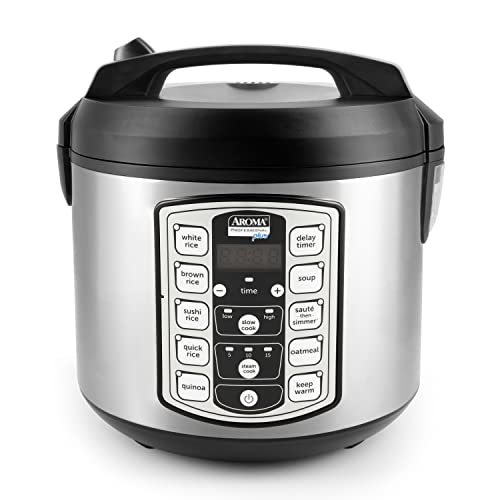
The highlights are replaces a rice cooker, pressure cooker, slow cooker, and yogurt maker with one appliance and massive review base (198,000+) reflects proven reliability across use cases. One caveat, rice quality and texture control trail a dedicated rice cooker's fuzzy logic.
The highlights are digital delay timer at a budget price point most single-thermostat cookers lack and 20-cup capacity handles large batches or events without stepping up in price. One caveat, no fuzzy logic, so brown rice and specialty grains cook inconsistently.
20-cup cooked capacity
Digital display with delay timer
Nonstick removable inner pot
Steam tray included
Single-thermostat cook/warm control
Cool-touch exterior
Pros
Digital delay timer at a budget price point most single-thermostat cookers lack
20-cup capacity handles large batches or events without stepping up in price
Removable inner pot simplifies cleanup versus fixed-pot competitors
Cons
No fuzzy logic, so brown rice and specialty grains cook inconsistently
Large footprint requires significant counter or storage space
Build quality feels less substantial than Zojirushi or Tiger at nearly the same size
Prices and availability change, so confirm on Amazon.
The highlights are zojirushi reliability and inner pot quality in a compact 3-cup size and steaming basket adds vegetable and fish steaming without a separate appliance. One caveat, no fuzzy logic, single-thermostat control like budget brands.
3-cup uncooked capacity
Simple cook/steam/warm switch
Nonstick inner pot
Includes steaming basket
Compact 7 to 8-inch footprint
Zojirushi build quality
Pros
Zojirushi reliability and inner pot quality in a compact 3-cup size
Steaming basket adds vegetable and fish steaming without a separate appliance
Small footprint suits dorm rooms and studio kitchens
Cons
No fuzzy logic, single-thermostat control like budget brands
3-cup ceiling means two cycles for larger households
Priced closer to fuzzy logic competitors despite basic thermostat control
Prices and availability change, so confirm on Amazon.
The highlights are 10-cup capacity brings pressure cooking's dense, fast-cooking texture to large families and gABA setting sprouts brown rice with elevated nutrient content, no Zojirushi equivalent.
10-15 PSI pressure cooking
10-cup uncooked capacity
GABA brown rice setting
Voice navigation (English/Korean)
Multi-grain and porridge programs
Stainless steel pressure lid with removable gasket
Pros
10-cup capacity brings pressure cooking's dense, fast-cooking texture to large families
GABA setting sprouts brown rice with elevated nutrient content, no Zojirushi equivalent
Pressure cooking roughly halves cook time versus standard fuzzy logic at this capacity
Cons
Pressure release is audibly loud, more noticeable at this larger capacity
Gasket and valve cleaning adds several minutes versus a standard lid
Prices and availability change, so confirm on Amazon.
This shortlist is the product of research, not advertising. We cross-checked manufacturer specs against independent reviews and long-term owner feedback, then ranked by value for real use cases.
Mistakes buyers often make
Buying on brand name alone instead of matching features to your actual use case.
Overpaying for headline specs you'll never use, define must-haves first.
Ignoring size, compatibility, and ongoing costs (filters, accessories, refills).
Trusting star ratings without reading what owners complain about after 6 months.
How we chose these picks
We started from manufacturer specifications and feature lists, the verifiable foundation.
We weighed reputable independent reviews from established tech and consumer publications.
We read large volumes of verified-owner feedback to find patterns in reliability and satisfaction.
We scored value: what you get for the price, not just absolute performance.
We excluded products with thin, suspicious, or heavily incentivized review profiles.
We don't claim hands-on testing we haven't done. Assessments synthesize manufacturer specifications, reputable independent reviews and documented owner feedback. Read our methodology.
Before you buy
Buying guide
How to choose: the factors that matter
Capacity and sizing, Measure your space and your actual use before falling for bigger-is-better. The right size is the one that fits your routine, not the spec sheet's maximum.
Build quality and materials, Heavier-gauge materials, tight tolerances, and solid joints outlast thin, rattly construction. In reviews, look for longevity comments over first-impression praise.
Ease of use and setup, Clear instructions, intuitive controls, and minimal assembly separate daily drivers from garage ornaments.
Maintenance and cleaning, Whatever you buy will need cleaning. Removable, dishwasher-safe, or wipe-clean parts get maintained; fiddly ones get neglected.
Warranty and support, A multi-year warranty signals the manufacturer expects it to last. Check what's actually covered, motors and frames matter more than accessories.
The bottom line
There's no single 'best' here, only the best match for your situation. Start from your must-have features, then choose the least expensive pick that covers them.
Answers
Frequently asked questions
What are the best rice cookers right now?
Our top pick is the Zojirushi NS-TSC10 Micom Rice Cooker (best overall), because most reliable performer across white, brown, and sushi rice in this ranking. The runner-up is the Zojirushi NS-YAC10 Fuzzy Logic Rice Cooker and Warmer, followed by the Cuckoo CRP-P0609S Pressure Rice Cooker.
Is the Zojirushi NS-TSC10 Micom Rice Cooker worth it?
For most buyers, yes. It ranks #1 in our rice cookers research, though 5.5-cup capacity requires a second cycle for very large households.
What is the difference between fuzzy logic and basic rice cookers?
A basic rice cooker uses a single thermostat: when the pot temperature rises above 212°F (indicating water has fully absorbed or evaporated), it switches from cook to warm. One sensor, one decision, adequate for white rice but cannot adjust for different rice types, altitude, or grain variability. A fuzzy logic rice cooker uses an internal computer with multiple sensors that measure temperature and cooking time throughout the cycle, then adjusts heat and timing based on rice variety selection and real-time readings. The result: more consistent grain texture across rice types, better handling of brown rice (which requires more water and longer cooking), and better results at altitude. For white rice only: a basic cooker is adequate. For multiple rice types or brown rice: fuzzy logic produces noticeably better results.
What is induction heating in a rice cooker?
Standard rice cookers heat from the bottom only, a heating plate under the inner pot. Induction heating rice cookers (Zojirushi NP and Cuckoo induction models) heat the pot from all sides simultaneously using an electromagnetic field. The result: more even heat distribution, faster heating to target temperatures, and the ability to achieve the socorrat or crispy bottom layer (nurungji in Korean) intentionally. For daily white rice and occasional brown rice: fuzzy logic is sufficient. For professional-level rice quality or specialty preparations (sushi rice, Korean rice): induction heating is worth the premium.
What size rice cooker do I need?
Rice cooker capacity is measured in cups of uncooked rice. 3-cup: for 1 to 2 people making 1 to 2 servings, compact but only fills 2 servings comfortably. 5-cup: the standard household size for 2 to 4 people, covers most family meal preparation. 8-cup: for families of 4 to 6 or meal prepping large batches. 10-cup: for large families, batch cooking, or serving guests. Rice doubles in volume when cooked, a 5-cup uncooked measure produces approximately 10 cups of cooked rice, serving 5 to 6 people as a side dish. Buy one size up from your typical use, running a 5-cup cooker at capacity produces slightly inferior rice to running it at 60% to 80% capacity.
Can a rice cooker make things other than rice?
Yes, most rice cookers can steam vegetables and fish using the included steam tray, make oatmeal and porridge using the porridge setting (fuzzy logic models), cook lentils and quinoa using the mixed or brown rice setting, and some can make simple cakes. Zojirushi fuzzy logic models include explicit settings for porridge, sweet rice, mixed rice, and steaming. The 'Multi-Cooker' marketed versions (Instant Pot rice mode) handle pressure cooking and slow cooking in addition to rice, different product category with different strengths. For rice as the primary use with occasional vegetable steaming: any rice cooker covers it. For multiple cooking methods: a dedicated multi-cooker alongside a rice cooker is more capable than a hybrid.
Do expensive rice cookers make noticeably better rice?
Yes, at the extremes. The differences: texture consistency (Zojirushi produces drier, more distinct grains; basic cookers can produce mushy centers in large batches), bottom-of-pot behavior (Zojirushi avoids scorching; basic cookers sometimes scorch the bottom layer at maximum capacity), and brown rice quality (fuzzy logic handles brown rice well; basic cookers often produce underdone or uneven brown rice).
How long can rice sit in the keep-warm mode?
Most rice cookers keep rice edible at safe temperature (140°F minimum) for 5 to 12 hours. Zojirushi and Cuckoo premium models include extended keep-warm with a timer that tracks how long the rice has been kept, they alert when rice has been in warm mode for an extended period. Beyond 4 to 6 hours: most rice begins to dry out and yellow, especially white rice. Brown rice holds texture slightly better. The extended warm feature in premium models uses lower temperature cycling to slow drying, quality at 6 hours is noticeably better than a basic cooker's warm mode at the same time. For making rice in advance to eat throughout the day: a Zojirushi with extended warm is the practical choice.