Frigidaire
Frigidaire FFRS0822SE 8,000 BTU Slider/Casement Air Conditioner
- Designed for slider and casement windows
- Remote and 24-hour timer
Everything you need to know about how to choose a window air conditioner: a decision framework, explained plainly.
Standard window air conditioners, including every model covered in this category, require a double-hung or single-hung sash window that raises vertically. The unit's chassis slides into the opening created when you raise the sash, with extendable side panels sealing the remaining gaps.
Match BTU rating to room size rather than buying the largest unit you can afford. Oversizing causes the compressor to short-cycle, cooling the air quickly but shutting off before it properly dehumidifies the room, which leaves the space feeling clammy despite a cool temperature.
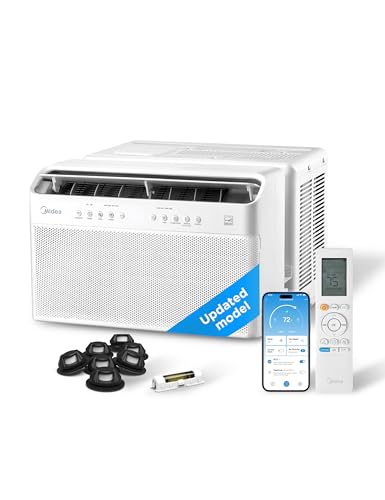
For a bedroom, home office, or any room you occupy for long stretches, an inverter compressor is worth the added cost. The Midea U-Shaped's 32 dBA low-fan rating and the GE Profile ClearView's 41 dB rating are both meaningfully quieter than a standard fixed-speed compressor unit like the LG LW8017ERSM1, which has no published low-noise rating.
Window Air Conditioners Buying Guide Best Window Air Conditioners for Small Bedrooms Best Window Air Conditioners for Casement Windows
Best Window Air Conditioners for Casement Windows: What Actually WorksWindow Air Conditioners · List Best Window Air Conditioners for Large Living RoomsWindow Air Conditioners · List Best Quiet Window Air Conditioners, Ranked by Decibel RatingWindow Air Conditioners · List
Standard window air conditioners, including every model covered in this category, require a double-hung or single-hung sash window that raises vertically.
The unit's chassis slides into the opening created when you raise the sash, with extendable side panels sealing the remaining gaps.
If your window is a casement (crank-out), slider, or awning style, a standard unit will not install.
See our casement window guide for the real alternatives: a portable AC with a casement window kit, a through-the-wall unit, or a ductless mini-split.
Match BTU rating to room size rather than buying the largest unit you can afford.
Oversizing causes the compressor to short-cycle, cooling the air quickly but shutting off before it properly dehumidifies the room, which leaves the space feeling clammy despite a cool temperature.
Add roughly 10% more capacity for a kitchen, a room with high ceilings, or one that gets consistent direct afternoon sun.
For an open floor plan connecting to other rooms, size up one tier from what the square footage alone suggests.
For a bedroom, home office, or any room you occupy for long stretches, an inverter compressor is worth the added cost.
The Midea U-Shaped's 32 dBA low-fan rating and the GE Profile ClearView's 41 dB rating are both meaningfully quieter than a standard fixed-speed compressor unit like the LG LW8017ERSM1, which has no published low-noise rating.
For a room used occasionally, like a guest room or a garage workspace, the noise difference matters less, and a standard fixed-speed unit is a reasonable way to save money.
Window Air Conditioners Buying Guide Best Window Air Conditioners for Small Bedrooms Best Window Air Conditioners for Casement Windows LG LW8017ERSM1 vs Midea U-Shaped Inverter AC
Standard window air conditioners require a double-hung or single-hung sash window that slides up vertically. If you only have casement (crank-out), sliding, or awning windows, a standard unit will not install at all, and you need a portable AC with the appropriate window kit or a through-the-wall unit instead.
As a rough guide: 150 sq ft needs about 5,000 BTU, 250 sq ft needs about 6,000 BTU, and 340 to 350 sq ft needs about 8,000 BTU. Add roughly 10% more capacity for a kitchen or a room that gets direct afternoon sun, and size up one tier for an open floor plan that connects to other rooms.
If the unit will run most of the day in an occupied room, like a bedroom or a living room, yes. Inverter compressors like the one in the Midea U-Shaped hold a steady, quiet output instead of cycling fully on and off, which saves on both noise and electricity over a full cooling season. For a room used only occasionally, the savings matter less.
Not for core functionality. Every unit in this category cools and dehumidifies the same whether or not it's connected to an app. Wi-Fi adds remote start, scheduling, and energy monitoring, genuinely useful conveniences but not something that changes the unit's cooling performance.