Frigidaire
Frigidaire FFRS0822SE 8,000 BTU Slider/Casement Air Conditioner
- Designed for slider and casement windows
- Remote and 24-hour timer
Everything you need to know about window air conditioners buying guide: everything to know before you buy, explained plainly.
Every other decision follows from getting BTU sizing right.
A unit sized too small never reaches a comfortable temperature on the hottest days.
A unit sized too large cools the air quickly, shuts off, and leaves the room humid because the compressor never runs long enough to properly dehumidify.
As a baseline: 5,000 BTU for up to 150 sq ft, 6,000 BTU for up to 250 sq ft, 8,000 to 8,300 BTU for up to 340 to 350 sq ft, and 12,000 BTU for up to 550 sq ft.
Add roughly 10% more capacity for kitchens, sun-facing rooms, or high ceilings.
A fixed-speed compressor, like the one in the LG LW8017ERSM1, runs at full power until the room hits temperature, then shuts off completely and restarts when the room warms up again.
This on/off cycling is where most of a window AC's noise and energy inefficiency comes from.
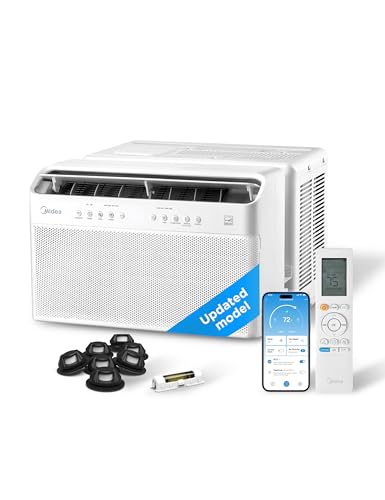
An inverter compressor, like the Midea U-Shaped's, ramps its output up and down instead of switching fully off, holding a steadier temperature with less noise and less energy spent on repeated startups.
The tradeoff is typically a higher purchase price.
Standard boxy frame: Slides into the window opening after raising the sash, with extendable side panels.
Simplest installation, but blocks the most window view and doesn't allow the sash to lock down.
U-shaped frame (Midea): Splits so the compressor sits outside the window while the sash lowers into a gap in the middle, allowing the window to lock for security.
Installation takes longer and often benefits from a second person.
Flex-depth, below-sill frame (GE Profile ClearView): Sits low in the window opening rather than filling it, preserving more of the view and natural light, and fits a wider range of wall thicknesses without extra parts.
Confirm your window is a double-hung or single-hung sash type that raises vertically.
Casement, sliding, and awning windows are not compatible with standard window units; see our casement window guide for the real alternatives in that situation.
Measure your window's width and the wall thickness at the window opening.
Most units fit a standard range of widths with extendable side panels, but very narrow or very wide windows may need additional support brackets or foam filler kits, usually sold separately or included depending on the model.
Energy Star certification indicates a unit meets a minimum efficiency threshold, and models like the Midea U-Shaped that carry an Energy Star Most Efficient award exceed that baseline further, roughly 37% better than the federal minimum standard in Midea's case.
Over a full cooling season running several hours a day, the difference between a standard-efficiency and a high-efficiency unit at the same BTU rating can amount to a meaningful difference in electric bill impact, generally more pronounced the longer and more often the unit runs.
Buying based on BTU alone without checking window compatibility.
The single most expensive mistake is discovering after purchase that your window type can't accommodate the unit at all.
Oversizing "to be safe." A bigger unit than the room needs doesn't cool better, it just cycles more aggressively and leaves the room feeling less comfortable at a similar temperature.
Ignoring the recall history of a specific model.
Midea's 2025 recall and repair program for some early U-shaped units is a real example of why checking a model's current status matters before buying new or secondhand.
How to Choose a Window Air Conditioner Best Window Air Conditioners for Quiet Operation Window Air Conditioner Not Cooling the Room
An inverter model, like the Midea U-Shaped's 37% efficiency gain over the federal standard, can meaningfully lower that figure over a full cooling season compared to a standard fixed-speed unit.
BTU measures raw cooling capacity, how much heat the unit can remove per hour. EER (Energy Efficiency Ratio) measures how much cooling you get per watt of electricity used. Two units with the same BTU rating can have meaningfully different operating costs if their EER ratings differ, which is where inverter compressors typically show an advantage.
Most window air conditioners last 8 to 12 years with reasonable maintenance, including seasonal filter cleaning and keeping the coil free of debris. Units run more hours per season in hot climates and tend toward the shorter end of that range, while units in milder climates or used only a few months a year often exceed it.
Off-season, generally fall through early spring, tends to offer better pricing since demand drops and retailers discount remaining inventory ahead of new model releases. Buying in the middle of a heat wave often means paying full price and dealing with limited stock of the specific model you want.