
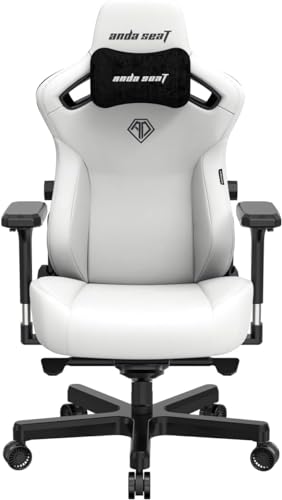
Best OverallAndaSeat
AndaSeat Kaiser 3 Large Gaming Chair
- Integrated lumbar adjusts both height and extension depth
- Cold-cure foam seat and backrest
Everything you need to know about gaming chair buying guide 2026: what actually matters and what doesn't, explained plainly.
Budget gaming chairs almost universally use a foam pillow held to the backrest by a strap.
This migrates during use, sits at the wrong height for most body types, and provides inconsistent support.
It is not a meaningful lumbar support system.
Premium gaming chairs (Secretlab TITAN Evo, Noblechairs HERO) use integrated spring-loaded or screw-adjustable mechanisms built into the backrest.
These stay at the position you set and maintain consistent contact with the lumbar curve.
Cold-cure foam is poured at room temperature and retains its shape and density under load for 3+ years.
Standard foam is cheaper, lighter, and softer initially, but compresses noticeably after 6 to 18 months of daily use.
Once the foam compresses, the chair sits lower, the lumbar lands at the wrong height, and the ergonomic benefit is lost.
Secretlab uses cold-cure foam and specifies it explicitly.
DXRacer and most budget brands do not.
Armrests are described by how many axes they adjust in: 3D: height, width, and depth 4D: height, width, depth, and angle 4D armrests allow the forearm to rest in the natural position relative to the keyboard and mouse, reducing the shoulder and neck compensation that causes secondary pain.
For long typing sessions, 4D is meaningfully better than 1D.
Budget chairs often claim 4D but deliver 2D with difficult-to-adjust mechanisms.
Most gaming chairs have seat widths between 17 and 21 inches.
Users with wider hips need a wider seat to prevent the seat walls from pressing against the outer thighs, which causes lateral pressure that shifts the pelvis and worsens lower back alignment.
Seat depth affects whether you can sit fully back in the chair while keeping your knees comfortably at a 90-degree angle.
A seat that is too deep forces users to either sit forward (losing back contact) or extend the legs to reach the floor.
Materials color and branding.
Logos on a gaming chair do not change the lumbar system, the foam, or the armrests.
The wing-shoulder and bucket-seat shape is a styling choice borrowed from motorsport, not an ergonomic design principle.
Some users find the bucket-seat shape comfortable; others find it restrictive.
Neither is inherently better.
Check three dimensions: seat width, seat depth, and backrest height. Seat width should be wider than your hip width by at least 1 to 2 inches on each side. Seat depth should allow your back to contact the lumbar support while your knees bend slightly off the seat edge (roughly 2 finger-widths gap). Backrest height should support the full length of your back with the headrest cushion at the base of your skull. Most gaming chairs are designed for users between 5'5 and 6'2 and 180 to 250 lbs. Outside those ranges, look specifically for chairs sized for your proportions.
Integrated lumbar support is built into the backrest and typically consists of a spring-loaded or screw-adjustable mechanism that pushes outward at a point you can raise or lower along the backrest. It stays at the position you set it regardless of how much you move. A pillow lumbar insert is a separate foam cushion strapped to the backrest with an elastic band. It migrates during use, slides to the wrong height when you adjust your position, and provides inconsistent contact with your lumbar curve. Integrated lumbar is significantly more effective for back pain. Pillow lumbar is better than nothing but is mainly a marketing feature at budget price points.
A premium gaming chair with cold-cure foam and a steel frame should last 3 to 5 years of daily use with maintained ergonomic quality. The foam in budget gaming chairs shows significant compression after 12 to 18 months. The hardware (gas lift, tilt mechanism, casters) typically lasts longer than the foam. PU leather surfaces peel at high-contact areas after 18 to 24 months in warm climates regardless of price tier; fabric and mesh surfaces last longer at the material level.
Gaming chairs are designed for recline and long gaming sessions, with high backrests that support the full spine and headrests that accommodate leaning back during gameplay. Office chairs are designed for upright seated work with forward tilt mechanisms suited to typing and monitor interaction. The correct answer depends on how you use the chair: if you game mostly reclined with a controller, a gaming chair suits that position better. If you game while typing or using a keyboard-heavy setup, an ergonomic office chair with forward tilt is ergonomically superior. Premium gaming chairs like the Secretlab TITAN Evo are competitive with mid-range ergonomic office chairs for both use cases.

