The highlights are holds a working edge for 4 to 6 weeks of daily home cooking before needing more than a honing steel and balance point sits exactly at the bolster where a pinch grip lands, so the knife feels neutral rather than blade-heavy. The tradeoff: 58 HRC steel is harder to sharpen on a whetstone than softer budget steels once honing stops restoring bite.
Forged single-piece high-carbon stainless steel at 58 HRC
Precision Edge Technology grind at 14 degrees per side
Full tang secured with three rivets
Contoured polyoxymethylene handle
Traditional German belly profile for rock-chopping
8.5-ounce weight balanced at the bolster
Pros
Holds a working edge for 4 to 6 weeks of daily home cooking before needing more than a honing steel
Balance point sits exactly at the bolster where a pinch grip lands, so the knife feels neutral rather than blade-heavy
Handle stays grippy when wet thanks to the polyoxymethylene material
18,000 ratings at 4.8 stars shows quality control has not drifted across a decade of production
58 HRC steel resists chipping against bone and hard squash better than harder Japanese steels
Cons
58 HRC steel is harder to sharpen on a whetstone than softer budget steels once honing stops restoring bite
Pronounced belly forces a rocking motion, which push-cutters may find limiting
At 150 dollars it costs 4 times more than the Victorinox for a smaller performance gap than the price suggests
Full bolster makes sharpening the heel of the blade awkward over years of use
Best for: buyers who want the best overall package
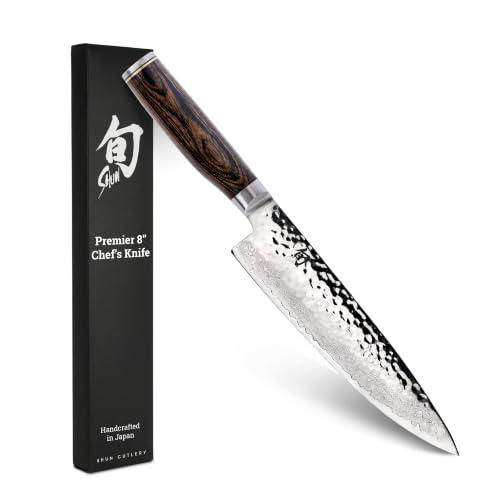
The highlights are 16-degree inclusive edge is noticeably sharper out of the box than any 28-degree German grind and thin grind splits dense carrots and squash with less resistance and less onion-cell crushing. The tradeoff: harder 60 to 61 HRC steel chips if twisted laterally against bone or frozen food.
VG-Max steel core clad in 34 layers of stainless Damascus
60 to 61 HRC hardness
16-degree inclusive edge grind
D-shaped pakkawood handle (left-handed version available)
7.7-ounce weight, balance forward of the bolster
Free lifetime sharpening by mail from Shun
Pros
16-degree inclusive edge is noticeably sharper out of the box than any 28-degree German grind
Thin grind splits dense carrots and squash with less resistance and less onion-cell crushing
Free lifetime sharpening by mail removes the barrier of learning whetstone technique
Edge retention outlasts every German knife on this list, running 4 to 6 weeks between sharpenings
5,200 ratings at 4.7 stars with most negative reviews tracing to misuse, not manufacturing defects
Cons
Harder 60 to 61 HRC steel chips if twisted laterally against bone or frozen food
Must be maintained on a whetstone; a grooved honing steel will chip the thin edge
D-shaped handle is polarizing for left-handed cooks unless they buy the left-handed version
Not suited to aggressive rock-chopping on a glass cutting board
Prices and availability change, so confirm on Amazon.
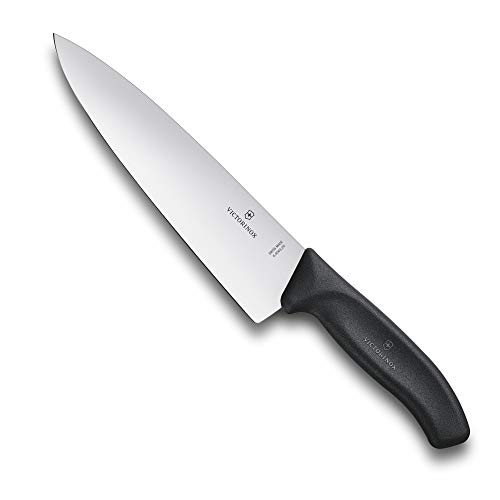
7 stars makes it the most battle-chef knife in existence with an effectively zero failure rate. The tradeoff: dulls to the tomato-crushing stage in 2 to 3 weeks of daily cooking, faster than any forged knife on this list.
Stamped X55CrMo14 stainless steel at approximately 56 HRC
15-degree edge per side, factory-sharpened
Thermoplastic elastomer Fibrox handle, slip-resistant when wet
No bolster, allowing full-length edge sharpening
Commercial dishwasher rated construction
Gently curved belly for both rocking and push-cutting
Pros
Delivers cutting performance closer to a 150-dollar knife than the roughly 35-dollar price suggests
42,000 ratings at 4.7 stars makes it the most battle-chef knife in existence with an effectively zero failure rate
Softer 56 HRC steel sharpens in half the time of harder steels, even with a basic pull-through sharpener
No bolster means the entire edge, including the heel, can be sharpened without obstruction
Slip-resistant handle stays secure through a 30-minute prep session even when wet
Cons
Dulls to the tomato-crushing stage in 2 to 3 weeks of daily cooking, faster than any forged knife on this list
Stamped rather than forged construction feels lighter and less substantial in hand than the Wusthof or Zwilling
Handle design is utilitarian and dated compared to the Victorinox Swiss Modern's updated grip
Requires more frequent sharpening than harder steels, which is a real time cost for cooks who dislike sharpening
Best for: value-focused buyers who want the most for their money
The highlights are cuts nearly as cleanly as the Shun through vegetables while handling bone-adjacent tasks better than any pure Japanese knife and dimpled blade face measurably reduces suction on potatoes and other dense produce during repetitive slicing. The tradeoff: thinner distribution than Wusthof or Shun makes finding one to hold before buying harder.
Proprietary high-carbon alloy steel at 59 to 61 HRC
15-degree edge, splitting German and Japanese grind angles
Dimpled blade face to reduce food suction
Pakkawood and stainless steel handle
6.8-ounce weight, one of the lightest on the list
Secondary bevel that resists chipping better than pure Japanese grinds
Pros
Cuts nearly as cleanly as the Shun through vegetables while handling bone-adjacent tasks better than any pure Japanese knife
Dimpled blade face measurably reduces suction on potatoes and other dense produce during repetitive slicing
Sharpens more easily than either pure German or pure Japanese steel despite the 59 to 61 HRC hardness
Most frequently recommended knife among professional cooks who have used everything and want low maintenance overhead
6.8-ounce weight and forward-of-heel balance suit both pinch grip and handle grip styles
Cons
Thinner distribution than Wusthof or Shun makes finding one to hold before buying harder
3,100 ratings is the smallest sample size among the top picks on this list
Pakkawood handle offers less tactile grip when wet than the Victorinox's textured elastomer
Proprietary steel alloy means replacement parts and warranty service are less standardized than major brands
Prices and availability change, so confirm on Amazon.
The highlights are arrives factory-sharper than most knives twice its price thanks to the 16-degree VG-10 edge and holds an edge for 4 to 6 weeks of daily home cooking, matching the Shun despite costing a fraction as much. The tradeoff: basic laminated wood handle is functional but unrefined next to the Shun's pakkawood or Mac's contoured grip.
VG-10 stainless steel core at 60 HRC, laminated with softer cladding
16-degree inclusive edge grind
True gyutou profile with a flatter belly
Laminated wood handle with bolster
Under 50 dollars for genuine Japanese laminated steel
Slightly blade-forward balance typical of gyutou knives
Pros
Arrives factory-sharper than most knives twice its price thanks to the 16-degree VG-10 edge
Holds an edge for 4 to 6 weeks of daily home cooking, matching the Shun despite costing a fraction as much
Cheapest entry point into genuine Japanese laminated steel construction on this list
Flatter gyutou profile rewards push-cutting and tap-chopping with cleaner cuts and less effort
VG-10 cladding provides real corrosion resistance for a budget-tier knife
Cons
Basic laminated wood handle is functional but unrefined next to the Shun's pakkawood or Mac's contoured grip
Same chipping caveats as any 60 HRC Japanese steel: no bone, no frozen food, no glass boards
Cooks coming from a German rocker knife need real technique adjustment for the flatter belly
4.5-star rating is the lowest among the Japanese options here, with some complaints tied to handle quality
Prices and availability change, so confirm on Amazon.
The highlights are convex grind noticeably reduces food adhesion during high-volume prep compared to flat-ground blades and seamless one-piece construction makes cleanup effortless with no crevices where food can lodge. The tradeoff: thin cylindrical handle fatigues hands that wrap fully around the grip after about 20 minutes.
One-piece CROMOVA 18 stainless steel construction
56 to 58 HRC hardness with a convex edge at 15 degrees per side
Sand-filled hollow handle for balance
Dimpled stainless grip surface
6.3-ounce weight, among the lightest on this list
Seamless design with no crevices for food buildup
Pros
Convex grind noticeably reduces food adhesion during high-volume prep compared to flat-ground blades
Seamless one-piece construction makes cleanup effortless with no crevices where food can lodge
6.3-ounce weight and handle-centered balance give it a uniquely agile, nimble feel for pinch-grip users
Edge retention lands between the Victorinox and the Shun, a genuine middle ground
Dimpled stainless surface stays grippy even when wet, despite the metal handle
Cons
Thin cylindrical handle fatigues hands that wrap fully around the grip after about 20 minutes
Distinctive all-metal design is polarizing and either sells the knife or kills it for a given buyer
Not as long-lasting on the edge as the Shun or Tojiro despite a similar sticker price
Sand-filled handle construction cannot be re-balanced or serviced if it ever fails
Prices and availability change, so confirm on Amazon.
The highlights are straighter edge profile keeps more blade on the board during push-cuts and tap-chops than the Wusthof's rocker belly and rounded bolster eliminates the common full-bolster German knife problem of an unreachable heel. The tradeoff: flatter profile is less efficient for cooks who prefer aggressive rock-chopping of herbs and garlic.
Sigmaforge single-piece special formula steel at 57 HRC
15-degree edge per side
Rounded bolster for full-heel sharpening access
Curved ergonomic Comfort Grip handle
Straighter blade profile than the Wusthof Classic
Balance point at the bolster
Pros
Straighter edge profile keeps more blade on the board during push-cuts and tap-chops than the Wusthof's rocker belly
Rounded bolster eliminates the common full-bolster German knife problem of an unreachable heel
Comfort Grip handle is genuinely more comfortable than the straight-handled Classic during sessions over 20 minutes
Edge retention comparable to the Wusthof Classic at 4 to 6 weeks between sharpenings
5,800 ratings at 4.7 stars confirms consistent build quality across a large sample
Cons
Flatter profile is less efficient for cooks who prefer aggressive rock-chopping of herbs and garlic
Costs about the same as the Wusthof Classic without the decades of brand recognition
57 HRC steel still requires the same whetstone commitment as other German knives once honing stops working
Comfort Grip handle shape is less traditional and may feel unfamiliar to cooks used to a straight German handle
Prices and availability change, so confirm on Amazon.
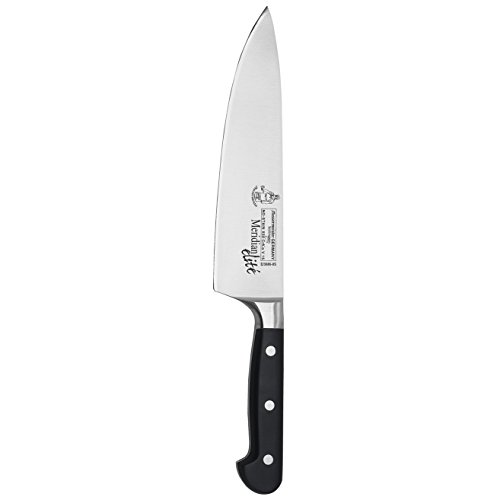
The highlights are thinner grind behind the edge reduces wedging in dense root vegetables compared to the Wusthof Classic and tapered bolster allows full-edge sharpening without the heel obstruction common on fully bolstered German knives. The tradeoff: limited retail distribution makes it hard to handle before buying.
German alloy steel at 57 to 58 HRC, hand-forged
Full tang with three rivets
15-degree edge per side
Thinner blade stock behind the edge than the Wusthof Classic
European-shaped POM handle with tapered bolster
Gentle belly for both rocking and push-cutting
Pros
Thinner grind behind the edge reduces wedging in dense root vegetables compared to the Wusthof Classic
Tapered bolster allows full-edge sharpening without the heel obstruction common on fully bolstered German knives
Competes directly with knives 30 to 50 dollars more expensive despite Messermeister's smaller market presence
Edge retention and sharpening behavior are in the same class as the Wusthof Classic
Neutral balance at the pinch grip suits both rocking and push-cut techniques
Cons
Limited retail distribution makes it hard to handle before buying
1,200 ratings is the smallest sample size of any product on this list, giving less long-term reliability signal
Lower brand recognition than Wusthof or Zwilling can make resale or replacement parts harder to find
57 to 58 HRC steel still needs the same periodic whetstone maintenance as any German knife
Prices and availability change, so confirm on Amazon.
The highlights are half-bolster exposes the heel so a whetstone can maintain the entire edge uniformly, unlike the full-bolster Classic and african blackwood handle is more ergonomic than the Classic's straight polyoxymethylene grip. The tradeoff: costs roughly 30 dollars more than the standard Classic for the same underlying blade steel.
Same high-carbon stainless steel as the Classic at 58 HRC
Precision Edge Technology grind at 14 degrees per side
Contoured African blackwood handle
Half-bolster design exposing the full heel for sharpening
Full tang construction
8.5-ounce weight with neutral balance
Pros
Half-bolster exposes the heel so a whetstone can maintain the entire edge uniformly, unlike the full-bolster Classic
African blackwood handle is more ergonomic than the Classic's straight polyoxymethylene grip
Same 58 HRC steel and edge geometry as the Classic, so cutting performance is proven and identical
4.8 stars across 3,400 ratings matches the Classic's reliability despite the handle redesign
Prevents the heel from becoming a permanent bump over years of sharpening, a real long-term maintenance advantage
Cons
Costs roughly 30 dollars more than the standard Classic for the same underlying blade steel
Blackwood handle requires slightly more care than synthetic handles to avoid drying out over years
Offers no edge retention or cutting performance improvement over the cheaper Classic, only ergonomics
Smaller rating pool than the original Classic makes very long-term durability data thinner
Prices and availability change, so confirm on Amazon.
The highlights are tsuchime dimples create air pockets that release potato and vegetable slices instead of letting them stick and ride up the blade and ambidextrous handle contour fixes the Classic's left-handed asymmetry issue. The tradeoff: costs more than the standard Shun Classic for a finish that only matters during high-volume slicing.
VG-Max steel at 60 to 61 HRC, same as the Shun Classic
The highlights are more contoured, contemporary handle sits more comfortably in a pinch grip than the Fibrox Pro's rounded profile and identical steel and edge retention to the proven Fibrox Pro, so cutting performance carries over directly. The tradeoff: costs more than the Fibrox Pro for what is largely a handle redesign rather than a performance upgrade.
Same X55CrMo14 steel as the Fibrox Pro at 56 HRC
Redesigned contemporary synthetic handle
Marginally straighter blade profile than the Fibrox
15-degree edge per side
No bolster for full-length sharpening access
Slip-resistant grip material
Pros
More contoured, contemporary handle sits more comfortably in a pinch grip than the Fibrox Pro's rounded profile
Identical steel and edge retention to the proven Fibrox Pro, so cutting performance carries over directly
Slightly straighter profile nudges the blade toward push-cutting for cooks who prefer that motion
No bolster allows sharpening the full edge including the heel, same as the Fibrox
Retains the Fibrox's fast, easy sharpening on a basic pull-through sharpener or whetstone
Cons
Costs more than the Fibrox Pro for what is largely a handle redesign rather than a performance upgrade
Same 2 to 3 week edge retention limitation as the Fibrox at 56 HRC
The straighter profile difference is subtle enough that most cooks will not notice it in daily use
Smaller rating pool than the Fibrox Pro offers less long-term validation
Prices and availability change, so confirm on Amazon.
This shortlist is the product of research, not advertising. We cross-checked manufacturer specs against independent reviews and long-term owner feedback, then ranked by value for real use cases.
Mistakes buyers often make
Buying on brand name alone instead of matching features to your actual use case.
Overpaying for headline specs you'll never use, define must-haves first.
Ignoring size, compatibility, and ongoing costs (filters, accessories, refills).
Trusting star ratings without reading what owners complain about after 6 months.
How we chose these picks
We started from manufacturer specifications and feature lists, the verifiable foundation.
We weighed reputable independent reviews from established tech and consumer publications.
We read large volumes of verified-owner feedback to find patterns in reliability and satisfaction.
We scored value: what you get for the price, not just absolute performance.
We excluded products with thin, suspicious, or heavily incentivized review profiles.
We don't claim hands-on testing we haven't done. Assessments synthesize manufacturer specifications, reputable independent reviews and documented owner feedback. Read our methodology.
Before you buy
Buying guide
How to choose: the factors that matter
Steel type, German steel (softer, ~56–58 HRC) is forgiving and easy to hone; Japanese steel (harder, 60+ HRC) holds an edge longer but chips more easily on bones and frozen food.
Blade length and profile, 8 inches suits most hands and boards. A gentle curve rocks herbs; a flatter profile suits push-cutting.
Handle comfort, This is personal, grip the knife in a pinch grip. Hotspots in the store become blisters at home.
Weight and balance, Heavier knives do the work for you; lighter knives offer control. Balance at or just ahead of the bolster feels natural to most.
Maintenance reality, Every knife dulls. Budget for a honing rod (German steel) or whetstones (Japanese steel), a sharp $60 knife outperforms a dull $200 one.
The bottom line
There's no single 'best' here, only the best match for your situation. Start from your must-have features, then choose the least expensive pick that covers them.
Answers
Frequently asked questions
What are the best chef knives right now?
Our top pick is the Wusthof Classic 8-Inch Chef Knife (best overall), because holds a working edge for 4 to 6 weeks of daily home cooking before needing more than a honing steel. The runner-up is the Shun Classic 8-Inch Chef Knife (best japanese), followed by the Victorinox Fibrox Pro 8-Inch Chef Knife.
What is the best budget option among chef knives?
Our best-value pick is the Victorinox Fibrox Pro 8-Inch Chef Knife: delivers cutting performance closer to a 150-dollar knife than the roughly 35-dollar price suggests. Check the current price on Amazon, since deals change often.
Which of the chef knives should I buy?
It depends on what matters most to you. For overall, choose the Wusthof Classic 8-Inch Chef Knife. For japanese, choose the Shun Classic 8-Inch Chef Knife. For value, choose the Victorinox Fibrox Pro 8-Inch Chef Knife. For hybrid, choose the Mac Knife MTH-80 Professional Series 8-Inch Chef Knife.
Is the Wusthof Classic 8-Inch Chef Knife worth it?
For most buyers, yes. It ranks #1 in our chef knives research, though 58 HRC steel is harder to sharpen on a whetstone than softer budget steels once honing stops restoring bite.
What is the best chef knife length for most home cooks?
It handles everything from mincing garlic to breaking down a whole chicken without being unwieldy on a standard 24-inch cutting board. A 10-inch blade adds leverage for heavy squash and watermelon but feels front-heavy to smaller hands and demands more counter clearance. Six-inch utility knives are too short to rock-chop herbs or slice through a cabbage in one pass. Start with an 8-inch, cook with it for six months, and only then consider whether a longer blade would solve a specific problem you actually have.
German vs Japanese chef knives: which is better?
Neither is categorically better; they solve different problems. German knives like the Wusthof Classic use softer steel around 56 to 58 HRC, ground to a 14 to 15 degree edge per side, making them tougher against bone and hard squash and easier to sharpen at home with a honing steel. Japanese knives like the Shun Classic use harder steel around 60 to 61 HRC, ground thinner to 16 degrees inclusive, giving a sharper initial edge that holds longer but chips if twisted against bone or frozen food. If you rock-chop a lot and treat knives roughly, German. If you value a laser-thin edge for precision vegetable work and are willing to use a whetstone, Japanese. If you want something in between, the Mac MTH-80 bridges both schools.
How often should I sharpen a chef knife?
Hone before every session, sharpen two to four times a year. Honing with a smooth steel or ceramic rod straightens a rolled edge and takes 30 seconds. Actual sharpening, which removes metal to form a new edge, is needed when honing stops restoring bite. That interval depends on the steel, the cutting surface, and how much you cook: a home cook who uses a wooden board might sharpen twice a year, while a line cook on a poly board may need it monthly. The tomato test is the reliable indicator. If a ripe tomato requires any downward pressure to start the cut, the knife needs sharpening, not honing. Japanese knives hold their edge longer between sharpenings but need a whetstone rather than a pull-through sharpener, which removes too much steel at the wrong angle.
Do I need a full tang chef knife?
Full tang is not the requirement people think it is. A full tang means the steel extends the entire length and width of the handle, which adds weight and theoretically durability. But a well-made half-tang or hidden-tang knife like the Victorinox Fibrox Pro or most Japanese gyutou has survived decades of professional kitchen abuse without tang failures. What you actually want is balance: a knife that does not feel blade-heavy or handle-heavy when you grip it at the bolster. The Victorinox is a half tang and is the most recommended budget chef knife in existence, used harder than most full-tang knives ever will be. Check the balance point, not the tang diagram.
Is a 30-dollar chef knife good enough?
The Victorinox Fibrox Pro at roughly 35 dollars has been the standard budget recommendation for over a decade because the steel takes a good edge, the handle is comfortable and slip-resistant, and the blade geometry is sound. It will not hold its edge as long as a Wusthof or a Shun, and it will need sharpening more frequently, but the actual cutting performance out of the box is closer to a 150-dollar knife than the price gap suggests. What the extra money buys on a premium knife is edge retention, handle material, balance refinement, and in the case of Japanese knives, a thinner grind that produces less resistance through dense vegetables. None of those are reasons to wait if you need a functional knife now.
Can I put a chef knife in the dishwasher?
You can, but you should not, and this is true regardless of what the manufacturer claims. Dishwasher detergent is alkaline and abrasive enough to corrode carbon steel and dull stainless steel over repeated cycles. The real damage, though, is mechanical: knives rattle against racks, other utensils, and each other, chipping and rolling the edge far faster than cutting food does. High-carbon Japanese knives will develop dark corrosion patches after a single cycle. Even German stainless knives lose edge quality measurably faster when dishwashed regularly. Hand wash with soap and water, dry immediately, and store on a magnetic strip or in a blade guard. This takes less time than loading and unloading the dishwasher.