
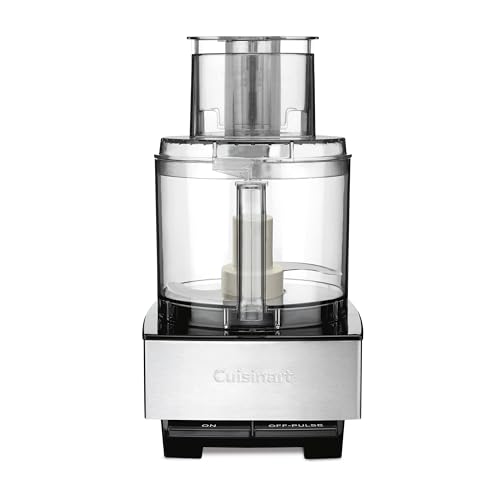
Top pickCuisinart
Cuisinart Mini-Prep Plus 4-Cup Food Processor DLC-2ABCY
- 4-cup work bowl, compact 5.25 x 5.75 x 8.5-inch footprint
- Stainless steel chopping blade with auto-reversing action for coarse or fine chop
8 fixes for a food processor that leaves chunks, over-processes some pieces, or produces uneven results, covering food load size, cut consistency, pulse technique, blade condition, bowl size match, a
Work through these in order, the most common causes come first.
Uneven chopping from a food processor falls into three categories: technique errors (fixes 1 to 3), hardware issues (fixes 4 to 5), and use-case mismatches (fixes 6 to 8). Work through the technique fixes first, they resolve 70% of uneven chopping complaints without any repairs or purchases. Cut all food to within 50% of the same size before processing.
Unplug (or remove batteries) for a full 60 seconds, not 5. This clears fault states that a quick toggle won't.
Try a different outlet, cable, and adapter. A surprising share of 'dead' devices are starved by a failing cable.
Look up the model's reset combination (usually holding a button 10+ seconds). Reconfigure from scratch afterward.
Check the companion app or manufacturer site for firmware updates that address known faults.
Uneven chopping from a food processor falls into three categories: technique errors (fixes 1 to 3), hardware issues (fixes 4 to 5), and use-case mismatches (fixes 6 to 8).
Work through the technique fixes first, they resolve 70% of uneven chopping complaints without any repairs or purchases.
Cut all food to within 50% of the same size before processing.
One large quarter and one small sliver produce different results.
Quarter onions; cut carrots into 1-inch pieces.
This is a density stratification issue, not a blade problem. During operation, the blade creates a vortex that pushes fine processed particles up toward the lid while coarser particles remain near the blade. After a long continuous run, the bottom becomes over-processed and the material at the top is large chunks that never reached the blade. Fix: use pulse technique instead of continuous run, pause every 5 to 7 pulses, and scrape down the sides and redistribute the contents with a spatula before continuing. The redistribution step is the critical part, scraping after each pulse series brings the outer and top material back into the blade path for even processing.
Three most likely causes: (1) The blade is dull, blade dulling is gradual and often not noticed until results degrade noticeably. Test: chop a single onion. If it takes twice as many pulses as it used to for the same result, the blade is dull. (2) The blade is not seated properly, check the seating and reinsert firmly. (3) You are using the continuous run setting more frequently instead of pulse, muscle memory can drift toward holding the run button rather than pulsing. Return to pulse technique and recheck results.
Yes, but with specific technique to avoid paste. Ground chicken from a food processor: use cold chicken (not frozen, not at room temperature, 34 to 38 degrees Fahrenheit from the refrigerator), cut into 1-inch cubes, and pulse 8 to 12 times watching between each pulse. Warm or room-temperature chicken produces paste in 3 to 4 pulses because the fat smears rather than cuts. For coarse ground similar to store-bought ground chicken: 8 pulses. For finer ground: 12 to 15 pulses. Never run continuously, continuous processing on raw chicken produces a paste in under 30 seconds. Process in small batches (no more than 1 pound at a time) for even results.

