
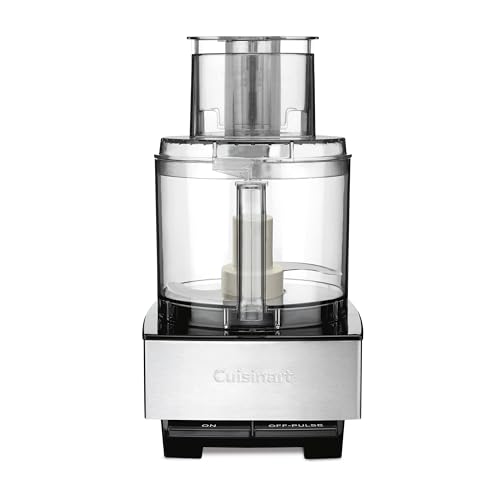
Top pickCuisinart
Cuisinart Mini-Prep Plus 4-Cup Food Processor DLC-2ABCY
- 4-cup work bowl, compact 5.25 x 5.75 x 8.5-inch footprint
- Stainless steel chopping blade with auto-reversing action for coarse or fine chop
Complete food processor buying guide covering bowl capacity, motor wattage, blade types, disc attachments, feed tube width, bowl material, and noise, everything you need to choose the right food proc
This guide covers the four specifications that most affect food processor performance and longevity: bowl capacity, motor wattage, blade and disc types, and seal design.
Read the section most relevant to your use case.
Food processor bowl capacity determines what quantities you can process without stopping to empty and re-run.
3 to 5-cup (mini): one onion, one cup of chickpeas, herbs for one batch of pesto, garlic for one week.
Not appropriate for slicing or shredding in any quantity.
Best as a secondary appliance for small tasks.
7 to 9-cup (compact/mid-size): half a head of cabbage, enough hummus for 4 people, a full bunch of fresh herbs, two cups of cooked beets.
Wattage ratings on consumer food processors are peak ratings.
Sustained (continuous) wattage is typically 60 to 80% of the peak rating.
What this means in practice: A 450W Hamilton Beach at sustained 300W heats up after 60 to 90 seconds of continuous operation and needs cooling breaks A 1,200W Cuisinart at sustained 900 to 1,000W runs for 5+ minutes without thermal protection interruption For tasks requiring less than 60 seconds of operation (chopping an onion, pulsing herbs): wattage is irrelevant, all food processors handle this.
For tasks requiring 2 to 5 minutes of operation (making hummus from scratch, kneading dough, shredding 2 pounds of cheese): wattage is the defining factor.
S-blade (chopping blade): The standard curved double blade.
Used for chopping, mincing, pureeing, making dough, and most food processing tasks.
Every food processor includes one.
Slicing disc: A flat disc with a single raised blade.
Food passes through the feed tube and contacts the blade to produce uniform slices.
The single feature that most affects daily convenience in a food processor is the feed tube width.
For slicing tasks: the feed tube determines how much pre-cutting is needed.
A 4-inch wide feed tube (Cuisinart DFP-14BCWN, Breville Sous Chef) takes a whole onion, whole tomato, and half a beet without cutting.
A 2-inch tube requires cutting every vegetable to a size that fits, adding 2 to 4 minutes per meal prep session.
Over 5 years of weekly use: the feed tube width difference represents 8 to 20+ hours of cumulative prep time.
Food processor lids seal the bowl at a specific locking point; the bowl-to-base connection uses a separate seal at the motor shaft.
Leaks occur at both points.
Lid seal: The lid's locking tabs engage a groove in the bowl rim.
Cheap seals develop play over time; premium seals maintain tight contact for years.
The locking mechanism is also a safety feature, the motor will not run if the lid is not fully locked.
Minimum wattage depends on use. For chopping soft vegetables, herbs, and making hummus or salsa: 250 to 400W is adequate, the Hamilton Beach 70730 at 450W handles these tasks without motor strain. For slicing harder vegetables (carrots, beets, sweet potatoes) and shredding firm cheese: 600 to 700W provides noticeably smoother operation and more consistent results without stalling. For sustained dough kneading, nut butter from raw nuts, and processing dense or fibrous ingredients: 900 to 1,200W is appropriate, the Cuisinart DFP-14BCWN at 1,200W is the benchmark for this level. Key rule: the wattage rating is peak power, not continuous power. A 700W budget motor runs at 350 to 500W sustained; a 700W Cuisinart motor runs at 700W sustained for minutes at a time.
A slicing disc (also called a slicing plate) uses a single exposed straight blade to cut food into uniform thin rounds as it passes through the feed tube under gravity. Adjustable slicing discs produce slices from 1mm to 6mm thick by rotating the disc to the marked position. A shredding disc (also called a grating disc) uses multiple small holes or serrated openings to shred food into thin strands as it passes through. Fine shredding disc: produces thin strands similar to a box grater's fine side, appropriate for parmesan, cheddar, and carrots for coleslaw. Coarse shredding disc: produces thicker strands similar to a box grater's large side, appropriate for potatoes, zucchini, and mozzarella. Both discs are typically included with 7-cup and larger food processors; mini food processors (4-cup and under) typically include only the S-blade.
Most food processor work bowls are made from BPA-free polycarbonate (hard, clear plastic). Higher-end models (Breville Sous Chef, Magimix) use thicker-walled bowls that vibrate less and feel more premium. The material difference matters in two ways: (1) Scratch resistance, thin polycarbonate scratches more easily from metal tools and abrasive ingredients, which makes the bowl look cloudy over time and can harbor bacteria in scratches; (2) Dishwasher compatibility, all modern food processor bowls are top-rack dishwasher safe, but thinner polycarbonate discolors faster from tomato-based foods and repeated dishwasher cycles. Bowl lids are typically the same material as the bowl. Some premium models (KitchenAid, Breville) include rubber grip handles on the bowl that make lifting easier.
The feed tube is the vertical opening in the food processor lid through which food is added during processing. Wide feed tube: 3 to 4 inches in diameter, accommodates whole onions, tomatoes, beets, and large carrots without pre-cutting. Standard feed tube: 2 to 2.5 inches in diameter, requires cutting most vegetables to fit. The feed tube matters most for slicing: food dropped through the feed tube rests on the slicing disc and slices into uniform rounds as the motor turns. A narrow feed tube means pre-cutting every potato, beet, or large carrot before slicing, adding time to each meal prep session. Premium models (Cuisinart DFP-14BCWN, Breville Sous Chef) include a dual feed tube with a wider outer ring and a narrower inner tube for small ingredients like cherry tomatoes. Minimum recommendation: a tube wide enough to fit a large onion without cutting.

