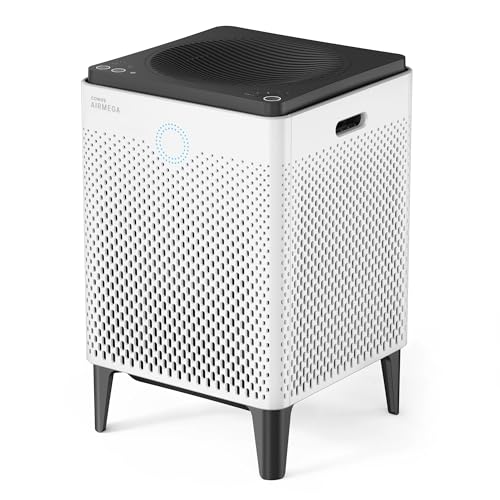
#1 Coway Airmega AP-1512HH Mighty True HEPA Air Purifier
Our top picks
On this page
Our top picks
Short on time? Our top recommendation is the Coway Airmega AP-1512HH Mighty True HEPA Air Purifier (best overall). Here's how the shortlist breaks down.
15 pounds of granular carbon is a magnitude beyond any carbon coating in this category, the only unit here that meaningfully handles gases and VOCs, not just particulate
15 pounds of granular carbon is a magnitude beyond any carbon coating in this category, the only unit here that meaningfully handles gases and VOCs, not just particulate
45 pounds and a large drum shape make it the least portable unit on this list by a wide margin
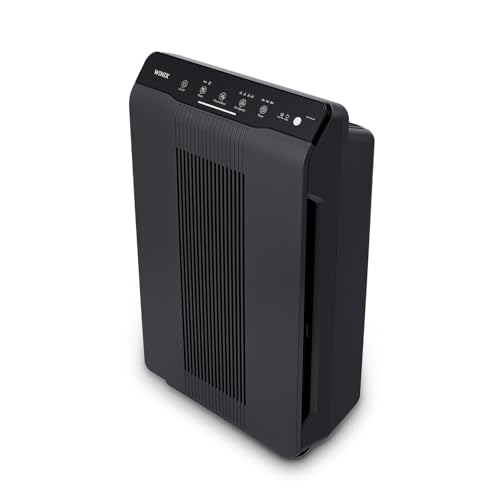
Its case rests on washable AOC carbon pre-filter meaningfully lowers long-term filter cost by extending HEPA life and 232 smoke CADR covers a genuinely mid-size room for well under the Coway's price. Keep in mind that plasmaWave ionizer should be switched off, and the control isn't obvious in the menu.
232 smoke CADR covers ~350 sq ft
Washable AOC carbon pre-filter
True HEPA filtration
PlasmaWave ionization (switch off)
4 fan speeds plus auto and sleep
Pros
Washable AOC carbon pre-filter meaningfully lowers long-term filter cost by extending HEPA life
232 smoke CADR covers a genuinely mid-size room for well under the Coway's price
Numeric auto-mode sensor gives visible feedback most budget competitors skip
30,000 ratings show consistent reliability over years of use
One of the best filter-cost-to-CADR ratios in the mid-size tier once PlasmaWave is disabled
Cons
PlasmaWave ionizer should be switched off, and the control isn't obvious in the menu
Plastic housing feels less substantial than the Coway's
Louder at top speed than the Coway or Levoit at comparable CADR
Washing the AOC filter is an extra maintenance step that, if skipped, shortens HEPA life
Prices and availability change, so confirm on Amazon.
Its case rests on real particle sensor with a numeric AQI display drives a genuinely responsive auto mode, not just a status light and app scheduling lets the unit run down automatically overnight without manual adjustment. Keep in mind that costs meaningfully more than the Core 300 for buyers who don't need Wi-Fi or auto mode.
~260 smoke CADR covers ~400 sq ft
Wi-Fi app control and scheduling
Particle sensor with numeric AQI display
True HEPA filtration
Quieter than Winix at equivalent speeds
Pros
Real particle sensor with a numeric AQI display drives a genuinely responsive auto mode, not just a status light
App scheduling lets the unit run down automatically overnight without manual adjustment
260 smoke CADR handily covers rooms the base Core 300 can't
Quieter than the Winix 5500-2 at matched fan speeds
28,000 ratings confirm the smart features hold up over real-world use, not just on paper
Cons
Costs meaningfully more than the Core 300 for buyers who don't need Wi-Fi or auto mode
App dependency adds setup friction and occasional connectivity quirks
Same thin carbon coating as the Core 300, so odor control is still limited
Proprietary cartridge not shared with other Core-series models
Prices and availability change, so confirm on Amazon.
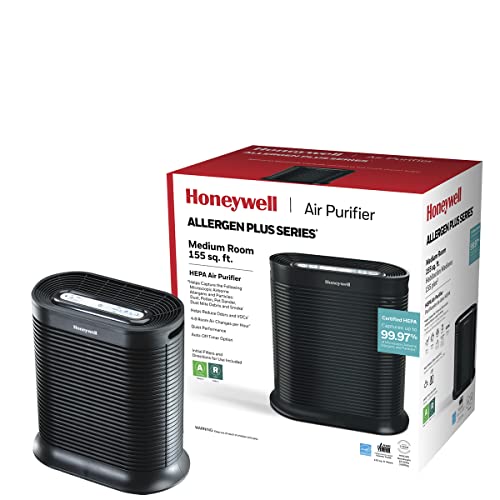
Its case rests on 350 smoke CADR is real capacity for an open-plan living space, not just a bedroom and single large fan reaches high CADR while staying under 56 dB at full speed, quieter than smaller units pushed harder. Keep in mind that larger physical footprint that needs real floor space.
350 smoke CADR covers ~540 sq ft
HEPASilent filtration technology
Washable fabric pre-filter cover
Single large fan stays under 56 dB at max
True HEPA capture at 99.97%
Pros
350 smoke CADR is real capacity for an open-plan living space, not just a bedroom
Single large fan reaches high CADR while staying under 56 dB at full speed, quieter than smaller units pushed harder
Washable fabric pre-filter cover extends the HEPA filter's usable life
22,000 ratings back consistent long-term reliability at this size class
HEPASilent design captures fine particulate without needing a screaming fan
Cons
Larger physical footprint that needs real floor space
No auto mode or particle sensor, fan speed is set manually
Minimal carbon means little help with cooking or pet odor
Higher price than mid-size units for households that don't need 540 sq ft of coverage
Prices and availability change, so confirm on Amazon.
Its case rests on 15 pounds of granular carbon is a magnitude beyond any carbon coating in this category, the only unit here that meaningfully handles gases and VOCs, not just particulate and welded steel construction means the purifier itself doesn't off-gas, notable for chemical sensitivity buyers. Keep in mind that 45 pounds and a large drum shape make it the least portable unit on this list by a wide margin.
15 lbs of granular activated carbon plus 4 lbs of zeolite
Welded steel body, no plastic off-gassing
Medical-grade HEPA rated for particulate down to 0.1 micron
No ionizer, UV, or plasma additions
5-year manufacturer warranty on the housing
Pros
15 pounds of granular carbon is a magnitude beyond any carbon coating in this category, the only unit here that meaningfully handles gases and VOCs, not just particulate
Welded steel construction means the purifier itself doesn't off-gas, notable for chemical sensitivity buyers
Medical-grade HEPA rated down to 0.1 micron exceeds the standard 0.3 micron true HEPA benchmark
Its case rests on wide, fur-ready intake handles shedding pets better than a generic HEPA opening and pet dander is a large particle, so this unit's design strength (intake, not raw filtration efficiency) is exactly where it matters. Keep in mind that no washable pre-filter, so fur loads directly onto the primary filter and shortens its life.
Wide intake designed for fur and large debris
True HEPA filtration for rooms up to ~300 sq ft
24 dB sleep mode
Display panel with fan speed indicator
Compact cylindrical design
Pros
Wide, fur-ready intake handles shedding pets better than a generic HEPA opening
Pet dander is a large particle, so this unit's design strength (intake, not raw filtration efficiency) is exactly where it matters
24 dB sleep mode keeps it usable in a bedroom shared with a pet
Compact footprint fits near a pet's usual resting area without crowding the room
18,000 ratings reflect consistent results specifically from pet-owning households
Cons
No washable pre-filter, so fur loads directly onto the primary filter and shortens its life
Thin carbon coating does little for pet odor beyond a few weeks post-filter-change
No auto mode, so speed must be bumped manually after a shedding session
Coverage tops out around 300 sq ft, undersized for open pet-friendly living areas
Prices and availability change, so confirm on Amazon.
Its case rests on slim tower footprint fits corners and narrow spaces that boxier units can't and true HEPA filtration at a genuinely low price point. Keep in mind that lower documented CADR than the Levoit or Winix units on this list, so real coverage is smaller than the tower's size suggests.
True HEPA plus UV-C and carbon filtration
Slim tower footprint for tight spaces
3-in-1 filter combining pre-filter, HEPA, and carbon
4 fan speeds
UV-C claimed to target airborne germs
Pros
Slim tower footprint fits corners and narrow spaces that boxier units can't
True HEPA filtration at a genuinely low price point
3-in-1 filter cartridge simplifies replacement to a single part
46,000 ratings show strong long-term satisfaction at this price
UV-C stage adds a marginal disinfection pass, at no CADR cost, for owners who want it
Cons
Lower documented CADR than the Levoit or Winix units on this list, so real coverage is smaller than the tower's size suggests
UV-C exposure time in a moving airstream is too brief to meaningfully disinfect, treat it as a minor extra, not a selling point
Carbon layer is thin and fades quickly on odor performance
No auto mode or particle sensor
Prices and availability change, so confirm on Amazon.
Its case rests on 17 dB minimum noise makes it one of the quietest purifiers available at any price and hEPASilent design reaches strong capture without needing a loud fan to hit its CADR number. Keep in mind that limited coverage of roughly 190 sq ft, bedroom-only.
HEPASilent filtration technology
As low as 17 dB on low speed
Washable fabric pre-filter cover
Compact footprint for nightstands
True HEPA capture at 99.97%
Pros
17 dB minimum noise makes it one of the quietest purifiers available at any price
HEPASilent design reaches strong capture without needing a loud fan to hit its CADR number
Washable fabric pre-filter cover extends HEPA life and comes in swappable colors
Compact size fits a nightstand without dominating a small room
Inexpensive to run continuously, which is how allergy and bedroom units should operate
Cons
Limited coverage of roughly 190 sq ft, bedroom-only
14,000 ratings is a smaller base than the Levoit or Winix units here
No meaningful carbon layer, so odor control is minimal
No auto mode or particle sensor, fan speed is manual
Prices and availability change, so confirm on Amazon.
Every pick below earned its place through documented strengths, verified specifications, consistent praise in reputable reviews, and owner-feedback patterns. We don't sell placements, and we don't invent test scores.
Mistakes buyers often make
Buying on brand name alone instead of matching features to your actual use case.
Overpaying for headline specs you'll never use, define must-haves first.
Ignoring size, compatibility, and ongoing costs (filters, accessories, refills).
Trusting star ratings without reading what owners complain about after 6 months.
How we chose these picks
We started from manufacturer specifications and feature lists, the verifiable foundation.
We weighed reputable independent reviews from established tech and consumer publications.
We read large volumes of verified-owner feedback to find patterns in reliability and satisfaction.
We scored value: what you get for the price, not just absolute performance.
We excluded products with thin, suspicious, or heavily incentivized review profiles.
We don't claim hands-on testing we haven't done. Assessments synthesize manufacturer specifications, reputable independent reviews and documented owner feedback. Read our methodology.
Before you buy
Buying guide
How to choose: the factors that matter
CADR and room size, Match the Clean Air Delivery Rate to your room: the purifier should cycle the room's air 4–5× per hour (ACH). Oversize slightly rather than undersize.
True HEPA filtration, True HEPA (H13) captures 99.97% of 0.3-micron particles. 'HEPA-type' or 'HEPA-like' are marketing terms with weaker standards.
Activated carbon, A substantial carbon filter helps with odors, VOCs, and smoke. Thin carbon sheets are mostly decorative.
Noise at working speeds, Check dBA at the speed you'll actually run, many units are whisper-quiet on low and loud on the speed that achieves their CADR.
Filter cost and life, Replacement filters are the real long-term cost. Compare annual filter spend, not just the unit price.
The bottom line
There's no single 'best' here, only the best match for your situation. Start from your must-have features, then choose the least expensive pick that covers them.
Answers
Frequently asked questions
What are the best air purifiers right now?
Our top pick is the Coway Airmega AP-1512HH Mighty True HEPA Air Purifier (best overall), because 246 smoke CADR correctly covers rooms up to about 360 sq ft, and Coway's own coverage claim actually matches the honest two-thirds-rule math. The runner-up is the Levoit Core 300 True HEPA Air Purifier, followed by the Winix 5500-2 True HEPA Air Purifier with PlasmaWave.
Is the Coway Airmega AP-1512HH Mighty True HEPA Air Purifier worth it?
For most buyers, yes. It ranks #1 in our air purifiers research, though 230 dollars at list, roughly double a Levoit Core 300 for coverage under twice the area.
What CADR rating do I need for my room?
CADR (Clean Air Delivery Rate) measures how many cubic feet of filtered air a purifier delivers per minuteseparately for smoke, dust, and pollen. The standard sizing rule is the two-thirds rule: your purifier's smoke CADR should be at least two-thirds of the room's square footage. A 300 sq ft bedroom needs a smoke CADR of 200 or higher. A 500 sq ft living room needs 333 or higher. This sizing delivers roughly 4.8 air changes per hour, which is the threshold most allergy and asthma guidance treats as meaningful. Undersizing is the most common purchase mistake: a unit rated for 200 sq ft running in a 500 sq ft room will filter the air, but so slowly that particle counts never drop far below ambient. When a manufacturer advertises a large coverage number without stating the air changes per hour it assumes, treat the claim as marketing rather than a specification.
What is the difference between true HEPA and HEPA-type filters?
True HEPA (also written as H13 or H14 in the European classification) is a defined standard: the filter must capture at least 99.97 percent of particles at 0.3 microns, the most-penetrating particle size. HEPA-type, HEPA-like, and 99 percent HEPA are marketing terms with no standard behind them, and those filters typically capture 85 to 95 percent at the same particle size. That gap matters most for the smallest particles: wildfire smoke, combustion byproducts, and viral aerosols sit in the 0.1 to 1 micron range where the difference between 95 and 99.97 percent compounds over repeated passes. For allergies from pollen and pet dander (larger particles, 5 to 30 microns), a HEPA-type filter still removes most of it. For smoke, ultrafine particulates, or a household with asthma: insist on true HEPA and check for the 99.97 percent at 0.3 microns language on the specification sheet.
Do air purifiers help with odors and gases?
HEPA filters capture particles, not gases. Odors, volatile organic compounds from paint or new furniture, cooking smells, and the gas phase of smoke pass straight through a HEPA filter. Removing those requires activated carbon, and the amount of carbon determines whether it works. A thin carbon-impregnated mesh (common in budget purifiers) adsorbs odors for a few weeks and then saturates. Meaningful gas removal requires several pounds of granular activated carbon, which is why the Austin Air HealthMate contains 15 pounds of it and weighs 45 pounds as a result. If odor control is a primary goal, look for the carbon weight in the specification, not the presence of the word carbon on the box. If particles are the goal, carbon is a secondary consideration.
Should I run an air purifier all the time?
Yes, continuously on a low or medium setting, rather than intermittently on high. Particles settle and re-suspend constantly as people move through a room, so a purifier that runs only a few hours a day lets concentrations rebuild between sessions. Continuous low-speed operation holds a steady low particle count and is quieter, more energy-efficient, and gentler on the fan motor than repeated high-speed bursts. Most modern purifiers draw 4 to 60 watts depending on fan speed, so continuous low operation typically costs 3 to 8 dollars per year in electricity. The exception is a room-specific event such as cooking smoke or a wildfire smoke episode: run high during and shortly after the event, then return to low.